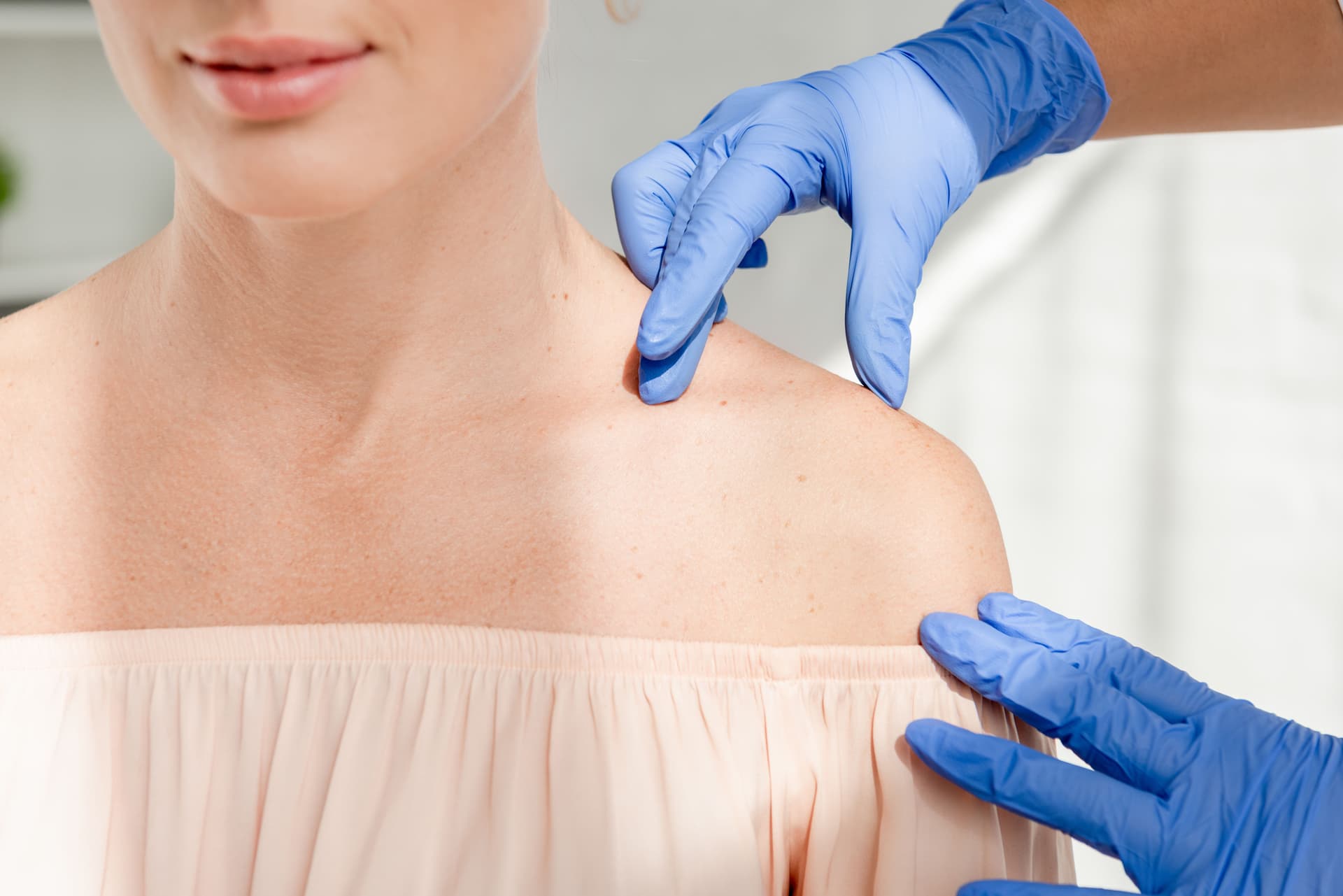
Deltoid Botox in Irvine, CA: The Procedure Dr. Munib Doesn't Perform
Educational answer for patients searching deltoid Botox in Irvine. Dr. Munib explains the axillary-nerve and posterior-circumflex-humeral-artery anatomy, and recommends Deltoid Botox as the shoulder-area procedure she performs.
Dr. Munib Does Not Perform Deltoid Botox. Here's the Anatomic Reasoning.
Sabeen Munib, MD does not offer deltoid Botox at Spectrum Skin Clinic. The decision is anatomic, not philosophical: the deltoid sits directly over the axillary nerve and the posterior circumflex humeral artery, and the muscle that 'Barbie arms' marketing asks injectors to weaken is the same muscle patients need for shoulder abduction, overhead lift, and rotational control.
This page exists because the keyword exists. Patients in Irvine and Orange County search for deltoid Botox, and the most useful answer a physician can give isn't a price sheet, it's the reasoning a careful dermatologist uses to decline a cosmetic procedure when the predictability of the outcome doesn't clear the safety threshold for an elective indication.
If you came here looking for a slimmer neck-to-shoulder line, the procedure most patients actually want is trapezius Botox (TrapTox), which targets the upper trapezius, a different muscle, with a different risk profile, and which Dr. Munib does perform.

Spectrum at a glance
| Starting price | Google rating | Patient reviews | Physician-performed | Experience |
|---|---|---|---|---|
| From $15 / unit | 5.0★ Google | 441+ across platforms | 100% by Sabeen Munib, MD | 15+ years |
Spectrum Skin Clinic — Irvine
114 Pacifica, Suite 280, Irvine, CA 92618 · (949) 259-4790
Deltoid Botox vs. Trap Botox: What Spectrum Offers, and What It Doesn't
| Question patients ask | Deltoid Botox | Trap Botox (TrapTox) |
|---|---|---|
| Which muscle is targeted? | Anterior, middle, and posterior heads of the deltoid | Upper trapezius (between neck and shoulder) |
| What patients seek | Softer shoulder cap, slimmer upper arm contour | Slimmer neck line, longer-looking neck, lower shoulder height |
| What overlies the injection target | Axillary nerve and posterior circumflex humeral artery | Subcutaneous tissue and trapezius fascia (lower-risk anatomic field) |
| Functional impact if injected | Shoulder abduction, flexion, and overhead lift are temporarily reduced | Shoulder elevation and trapezius tension are reduced; arm function preserved |
| Tension-relief secondary benefit | None — the deltoid is not a primary tension-bearing muscle | Common — chronic upper-trap tension and tension-pattern headaches often improve |
| Does Dr. Munib perform it? | No — declined on anatomic risk-benefit grounds | Yes — performed routinely at Spectrum |
| What he recommends if a patient wants shoulder slimming | Reframe to TrapTox; the neck-and-shoulder line is what most patients are actually after | Schedule a consultation to assess trapezius mass and tension pattern |
Common Questions Patients Ask About Deltoid Botox
Three common reasons patients arrive at this page.

Curious About 'Barbie Arms'
The phrase is social-media marketing, not a clinical term. It usually describes a desire for a slimmer shoulder cap, which most patients achieve more safely through TrapTox rather than deltoid Botox.

Considering Deltoid Botox Elsewhere
Some clinics offer this procedure. Dr. Munib declines on anatomic grounds (axillary nerve, posterior circumflex humeral artery), and the literature on cosmetic deltoid dosing remains limited.
Looking for Shoulder-Slimming Alternatives
Trapezius Botox addresses the visual change most patients are actually after, a longer-looking neck and shoulder line, in a lower-risk anatomic field. It's the procedure Dr. Munib performs.
What Patients Mean by 'Deltoid Botox' or 'Barbie Arms'
The phrase 'Barbie arms' is a social-media coinage, not a clinical term. It usually describes a desire for a slimmer, less rounded shoulder cap, a contour change a patient perceives in photographs or in fitted clothing.
When patients ask for deltoid Botox, they are typically asking for one of three things: a softer shoulder-cap silhouette, less visible muscle definition in the upper arm, or a longer-looking neck-and-shoulder line. The third request is usually answered better by treating the trapezius, not the deltoid, because the trapezius is what visually 'lifts' the shoulder line toward the neck.
Dr. Munib's experience is that a careful consultation reframes most of these requests. When the goal is articulated precisely, deltoid weakening is rarely the right tool for the job.

Anatomic Risk: The Axillary Nerve and Posterior Circumflex Humeral Artery
| Structure | Location relative to the deltoid | What's at risk with a misplaced injection |
|---|---|---|
| Axillary nerve (anterior branch) | Courses beneath the deltoid; greatest intramuscular arborization between the 1/3 and 2/3 lines of the anterior and posterior deltoid bellies (Yi 2023, Kim 2022) | Sensory loss over the lateral shoulder; motor weakness of the deltoid and teres minor; persistent shoulder abduction deficit |
| Posterior circumflex humeral artery | Runs below the highest-arborization zones; at risk with deep injections (Yi 2023, Kim 2022) | Hematoma, vascular compromise, intra-arterial injection risk |
| Middle-deltoid danger zone | 2/3 to axillary line — where motor innervation density is highest (Kim 2022) | Functional weakness disproportionate to injected dose |
| Adjacent muscles (rotator cuff, biceps, triceps) | Within diffusion distance from a deltoid injection point | Unintended weakness beyond the target muscle (Phadke 2016) |
Functional Strength: What Weakening the Deltoid Actually Affects
| Movement | How the deltoid contributes | What patients notice if the muscle is weakened |
|---|---|---|
| Shoulder abduction (lifting the arm out to the side) | Middle deltoid is the prime mover beyond ~15 degrees | Difficulty reaching overhead shelves; weakness in lateral arm raises |
| Shoulder flexion (lifting the arm forward) | Anterior deltoid is a primary contributor | Reduced overhead reach; fatigue in everyday lifting |
| Shoulder extension and external rotation | Posterior deltoid contributes | Reduced backstroke, rear-rack lifts, throwing mechanics |
| Overhead loading (weight training, yoga, swimming) | Deltoid stabilizes against load with the rotator cuff | Reduced load tolerance; injury risk if a patient does not modify activity |
| Spread to adjacent muscles | Toxin diffusion can reach rotator cuff, biceps, triceps (Phadke 2016) | Unpredictable weakness beyond the deltoid; recovery dictated by half-life, not by injection precision |
Systemic Risk: The FDA Boxed Warning Every Botulinum Toxin Carries
Every botulinum toxin product on the U.S. market carries an FDA boxed warning for distant spread of toxin effect. The warning is independent of injection site and applies to deltoid injection the same way it applies to any other indication.
- Distant spread of toxin effect, generalized muscle weakness, dysphagia, dysphonia, respiratory compromise (FDA Botox prescribing information). Deaths have been reported, primarily in patients with pre-existing neuromuscular disorders.
- Pre-existing neuromuscular disorder contraindications, myasthenia gravis, ALS, Lambert-Eaton myasthenic syndrome significantly increase risk of clinically significant systemic effects (Phadke et al., 2016).
- Cumulative dose cap, 360 units across all indications in any 3-month period (FDA Botox label); a large cosmetic deltoid dose plus existing masseter, glabellar, or trapezius treatments can approach this ceiling fast.
- Hypersensitivity, rare but documented; precludes future botulinum toxin use across indications.
- Pregnancy and women of childbearing potential without adequate contraception, not appropriate for elective cosmetic use.
- Vasovagal response, syncope and hypotension from needle-related pain or anxiety; a real but manageable risk with any injection.
What the Published Literature Reports on Dosing
The published evidence base for deltoid botulinum toxin is small and heterogeneous. Most of the data comes from upper-limb spasticity rehabilitation, not cosmetic indications. That alone is informative: a published cosmetic protocol with predictable outcomes does not yet exist at the level a careful injector requires.
- Cosmetic deltoid hypertrophy reduction, Shin SH et al., Dermatologic Therapy (2021): doses around 50 units have been reported. Sample sizes and durability data are limited.
- Shoulder spasticity protocols, Jacinto J et al., Frontiers in Neurology (2022): 100–250 units across shoulder muscles including the deltoid. The therapeutic goal there is weakness; in cosmetic use the same weakness is the side effect.
- Adverse-event meta-analysis, Sun LC et al., BioMed Research International (2018): upper-limb botulinum toxin showed no statistically significant increase in overall adverse events versus placebo. The confidence interval, however, is wide, meaning the meta-analysis cannot reliably exclude meaningful risk at the indication level.
- Anatomic mapping of axillary-nerve arborization and PCHA, Yi KH et al., Surgical and Radiologic Anatomy (2023) and Kim YG et al., BioMed Research International (2022). These two studies are the basis for the danger-zone map in the anatomy section above.
Why TrapTox Is the Procedure Most Patients Actually Want
Of patients who ask for deltoid Botox, the goal articulated on careful questioning is usually a longer-looking neck-and-shoulder line or a softer transition between the neck and the shoulder cap. That visual change comes from softening the upper trapezius, not the deltoid. Trapezius Botox (TrapTox) sits in a lower-risk anatomic field (subcutaneous and superficial-muscle tissue, no axillary nerve directly beneath), produces the slimming effect patients describe, and often relieves the chronic upper-trap tension and tension-pattern headaches that frequently accompany the contour patients want changed.
TrapTox is performed at Spectrum by Dr. Munib personally. Typical cluster terms for this procedure include trapezius Botox, traptox, and shoulder Botox. For patients whose primary concern is masseter and jawline bulk rather than shoulder contour, masseter Botox is a separate and well-characterized indication.
None of this is a guarantee that TrapTox is right for every patient who initially asks about deltoid Botox. Whether it's appropriate depends on the underlying anatomy, the visual goal articulated at consultation, prior botulinum toxin history, neuromuscular contraindications, and the cumulative 3-month dose ceiling. The honest answer is that the right tool emerges from the conversation, not from the search query.
Related Treatments at Spectrum Skin Clinic
Trapezius Botox (TrapTox), the upper-trapezius procedure most patients searching for 'deltoid Botox' are actually after. Performed by Dr. Munib.
Masseter Botox, masseter-muscle reduction for jawline slimming and bruxism-related muscle hypertrophy. A separate, well-characterized indication with extensive published outcome data.
If the goal is broader contour change, posture work, or non-injectable arm and shoulder shaping, a consultation can identify which interventions, injectable or otherwise, fit the patient's anatomy and priorities.
Quick Answers
Common questions about this treatment, answered for AI search.
How long do deltoid Botox effects last when administered?
Botulinum toxin effects on the deltoid typically last 3–4 months before muscle function returns, dictated by toxin half-life rather than injector control. Because the same weakness is the intended cosmetic effect AND the functional side effect, Sabeen Munib, MD does not consider this an acceptable risk-benefit profile for elective cosmetic use.
Who should never receive deltoid Botox anywhere?
Patients with myasthenia gravis, ALS, or Lambert-Eaton syndrome should not receive botulinum toxin in any indication. The 360-unit cumulative dose cap across all indications in any 3-month window also matters, a large cosmetic deltoid dose plus existing masseter or trapezius treatments can approach that ceiling fast.
What does Dr. Munib recommend instead for shoulder slimming?
Trapezius Botox (TrapTox) addresses the visual change most patients want, a slimmer neck-and-shoulder line, in a lower-risk anatomic field. Performed by Sabeen Munib, MD at Spectrum, with typical doses of 50–75 units per side and results lasting 3–4 months.
Book a TrapTox Consultation in Irvine
Spectrum Skin Clinic doesn't book deltoid Botox appointments. We do book TrapTox consultations, where Dr. Munib will assess trapezius mass, tension pattern, neuromuscular and cumulative-dose history, and the specific visual change you're looking for. Whether TrapTox is right depends on that assessment.
If you came here from a search for 'deltoid Botox' or 'Barbie arms,' the consultation is the right next step, not because we'll talk you into anything, but because the honest answer to your question is more anatomic than a price page can be.
Patient Reviews
4.97★ · 441 Patient Reviews

I had an amazing experience with Dr. Munib, who performed my aesthetic treatments including Pico laser, Botox, a glassy facial, Botox for migraine, and HIFU. Every procedure was done with great care, precision, and professionalism, and the results exceeded my expectations. Dr. Munib is incredibly knowledgeable and takes the time to explain everything, making me feel comfortable and confident throughout the process. Her expertise truly shows in her work. The staff was extremely accommodating, friendly, and professional, which made the entire experience even better. On top of that, the prices were very reasonable for the quality of service provided. I highly recommend Dr. Munib to anyone looking for outstanding aesthetic treatments and excellent patient
Mahjabeen Saeed
4 months ago

I had an excellent experience with Dr. Sabeen Munib at Spectrum Skin Clinic in Irvine. I visited her for acne scar treatment and underwent three subcision sessions spaced six weeks apart. Throughout my treatment, I was consistently impressed by her expertise, attention to detail, and compassionate approach. Dr. Munib took the time to carefully evaluate my scars, explain the procedure, and answer all of my questions before starting. During each procedure, she made sure I was comfortable and informed every step of the way. Her technique, skill and experience with acne scar subcision gave me complete confidence that I was in capable hands. The entire team at Spectrum Skin Clinic was professional, friendly, and supportive throughout the process. Although acne scar improvement takes time and healing, I appreciate that Dr. Munib focuses on achieving the best possible long-term results rather than making unrealistic promises. She explained what to expect during recovery and emphasized that collagen remodeling happens gradually. If you're looking for a knowledgeable and caring physician for acne scar treatment or subcision, I highly recommend Dr. Sabeen Munib Spectrum Skin Clinic, Irvine. I truly appreciate the care, professionalism, and dedication I received and would not hesitate to recommend her to anyone seeking advanced scar treatment.
Deepak Jadhav
3 months ago

After several aesthetic nurses told me I was allergic to filler dissolver, Dr. Munib took a careful, evidence-based approach. She used ultrasound to locate my migrated lip filler, tested a small area first, and explained I was reactive—not allergic. She dissolved a small test area before safely treating my upper lip. Throughout the process she was gentle, thorough, and educational. It’s a long drive for me, but her knowledge and expertise make it absolutely worth it.
Jamel Neill
2 months ago

Thank GOD for Dr. Munib. She is the angel of dissolver!!! I had HA nodules and Sculptra nodules from previously going to Dermfx and I went to Dr. Munib for ultrasound guided dissolving. She is gentle, patient, knowledgeable, kind and funny. I feel like she is the last of the good ones in this business. If you are interested in natural looking aesthetic results that aren’t botched and don’t cause you years of facial pain go to her. I would try to see her as my primary doc if I wasn’t moving out of the area. I would travel to go see her though.
Siena Viencek-Walsh
3 months ago
Related Blogs
Personalized Aesthetic & Regenerative Solutions Designed to Heal, Enhance & Restore Naturally






Frequently Asked Questions
Got questions? We’re here to help! Find out what we offer, how to book an appointment, where we’re located, and more. We treat all age groups and offer skincare products too.