

Temporary fullness
No extended downtime
Three to six months
Up to about 2 years
Massage as directed
Overview
Sculptra in Irvine and Orange County
Sculptra is an injectable poly-L-lactic acid, a collagen biostimulator made by Galderma. It does not fill a line the day it goes in. The microparticles sit in the deeper skin and prompt the body to lay down its own collagen over the following months.
Collagen loss is diffuse before it is focal. The temples flatten, the lateral cheek loses its support, the midface deflates, and the folds beside the nose deepen. Sculptra is placed across these zones to rebuild structure gradually, reshaping the lateral face and firming skin along the lower face and softening jowls, where laxity rather than a single fold explains the change.
As collagen returns the face lifts, which is why Sculptra suits sagging skin and loss of facial shape more than one crease.
Sabeen Munib, MD performs every Sculptra injection at Spectrum Skin Clinic in Irvine. Patients near Irvine and across Orange County are describing the same treatment whether they call it a collagen-stimulating filler, a biostimulator injection, or simply Sculptra. The wording does not change the plan. The anatomy does.

The Spectrum approach
Why collagen, not a syringe of gel, does the work here
Sculptra relies on a low-grade, controlled inflammatory response in the dermis. That response is what recruits collagen, and it is also why placement matters. Material left in an uneven deposit can firm into a palpable bump instead of smooth support.
Dr. Munib reads the face at rest and judges where support has been lost before any injection. The number of sessions follows the degree of collagen loss, not a fixed package.
She places every injection herself. Sculptra is not handed to an esthetician here, because the plane and the spread of the material decide whether the result is even.
Personally performed
Collagen based
Planned series
Informed consent
Before & After
Laser Skin Resurfacing Before and After
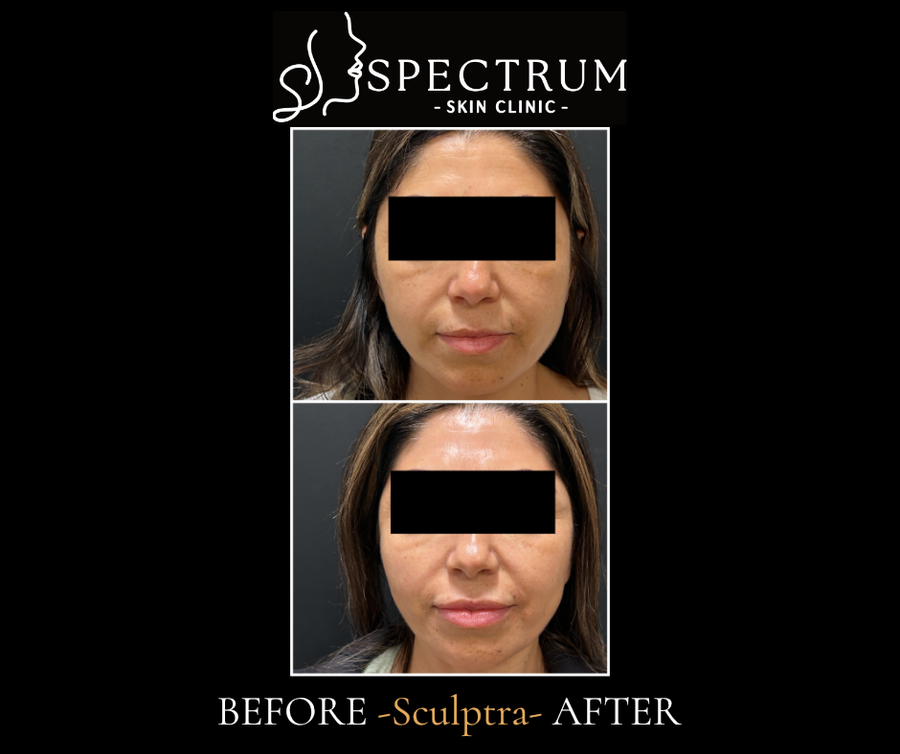
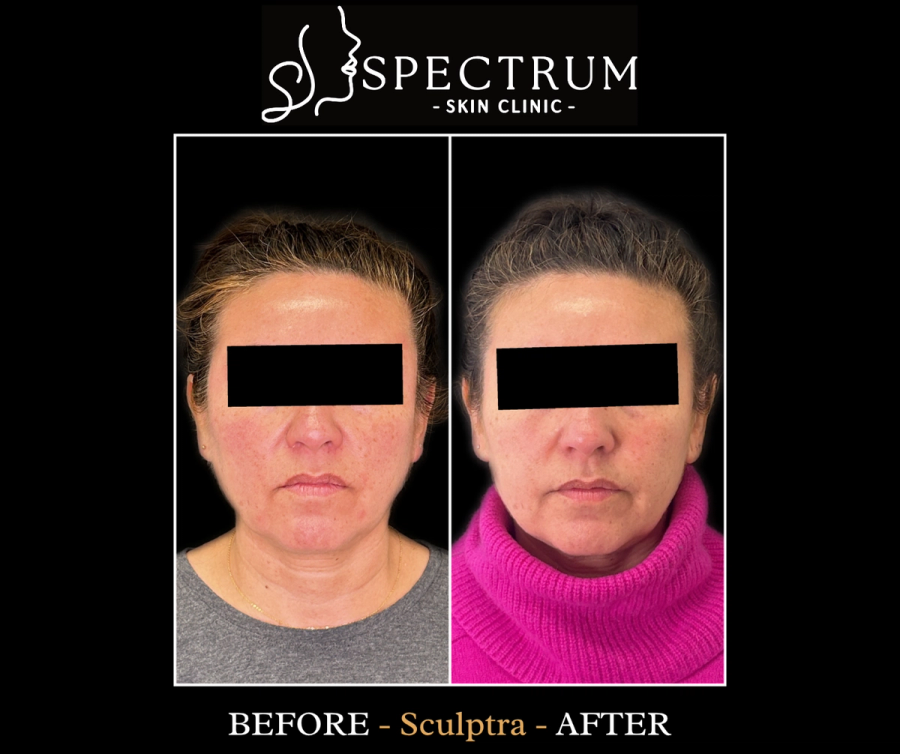
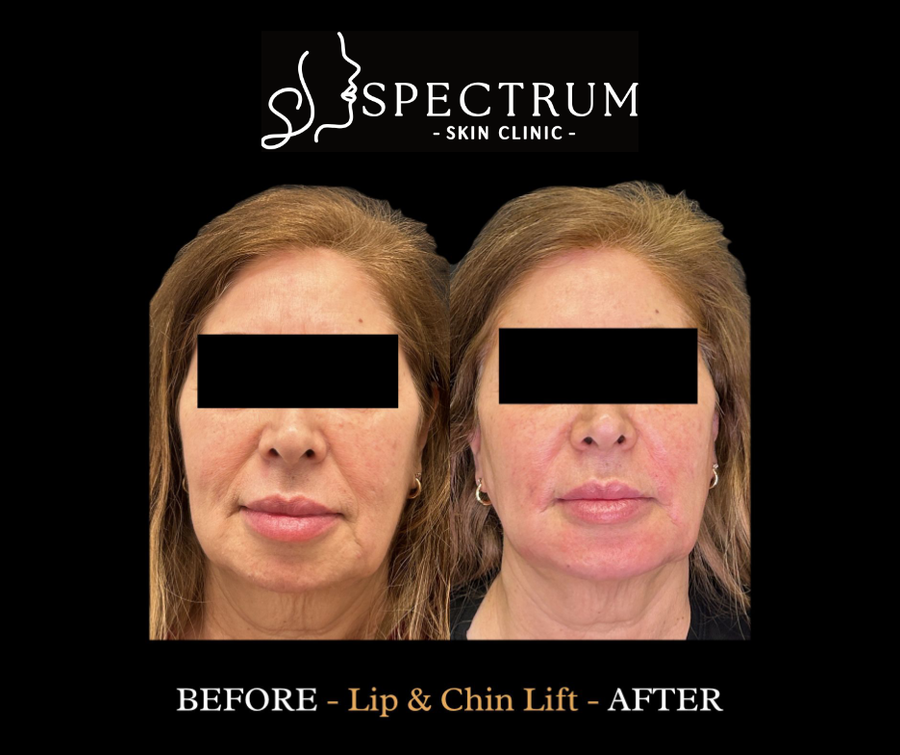
Every Sculptra result shown here was treated by Sabeen Munib, MD. Collagen builds slowly, so these photographs are taken months apart, not days.
How Sculptra works
Poly-L-lactic acid has been used in medicine for more than thirty years, in sutures and implants, because the body breaks it down and clears it. Injected into the deeper skin, the microparticles are not the result. They are a prompt.
Each particle triggers a quiet, controlled inflammatory response, and fibroblasts answer it by producing type-I collagen, the tissue the body uses to repair and support skin. Biopsies show that collagen rising at three and six months after injection. The volume you see is your own tissue, which is why it arrives slowly and why it cannot be dissolved the way a hyaluronic acid filler can.
What this means for the result
Because the collagen builds over months, one session rarely finishes the work. Sculptra is given as a planned series, spaced over weeks, so each round of collagen can mature before the next is judged. The early swelling after an injection can look like a finished result, but it settles within a few days and is not what was built.
This is also why Sculptra is the wrong choice when someone wants a visible change for an event next week, or wants a single deep fold corrected on the spot. A hyaluronic acid filler does that. Sculptra answers diffuse volume loss and skin that has thinned, not one line.
Which injectable fits which anatomy
Sculptra, hyaluronic acid filler, or another biostimulator
Not every volume loss is answered by the same material. What fits depends on the tissue and how fast a change is wanted.
Combined approaches
What Sculptra is paired with
Who may be a candidate
Sculptra suits a face losing volume broadly rather than in one spot. Flattened temples, a deflating midface, and softening along the lower face respond to rebuilt collagen. In selected patients it also firms the skin and gives a mild tightening where laxity, not a single fold, is the change.
How Dr. Munib decides
She weighs how much volume has been lost and where, how quickly you want a change, and the quality of the skin over the loss. When laxity and thinning, rather than a single crease, explain what you see, a biostimulator is considered before a standard filler. The plan follows the face in front of her, which is why the consultation comes first.
A good fit
You are seeing diffuse volume loss across the temples, cheeks, and lower face, you want a gradual change, and you can wait a few months for collagen to build. Patients who have had a hyaluronic acid filler and want something longer lasting often fit here.
When it is not the answer
A single deep fold, a lip, or a change needed before an event in days is not Sculptra's strength, and a hyaluronic acid filler is placed instead. Some medical histories rule it out, which is why suitability is decided at an in-person evaluation rather than in advance.
What to expect
What happens, and when
The quiet weeks between the preview fading and collagen building are normal. Judging the result too early is the most common reason a patient worries without cause.
Documented risks
What can go wrong, and why
Every injection carries some risk, and Sculptra's mechanism creates a specific one worth naming plainly.
Injection-site swelling and bruising
Needles bruise, and the early puffiness after a session can briefly mimic the finished result. Both settle within a few days and are not the collagen that was built.
Firmness and nodules
The inflammatory response that recruits collagen can also firm into a small palpable bump if the material settles unevenly. Even spread and placement in the correct plane are how that is kept rare, which is one reason the injection is not delegated.
It cannot be dissolved
A hyaluronic acid filler can be broken down with an enzyme if the result is wrong. Sculptra is your own collagen, so it is not reversible that way. This is the strongest reason to treat gradually and reassess between sessions.
These points are reviewed with you before treatment so the decision to proceed is an informed one, not a disclaimer read afterward.
How safety is handled here
Poly-L-lactic acid has a long record in medicine, and the material itself is broken down and cleared by the body over time.
Dr. Munib reviews your history and the skin at the injection sites before any treatment, and works in stages so each round can be judged before the next.
Aftercare and recovery
What affects your cost
What Sculptra costs in Irvine
The total depends on how much volume has been lost and how many sessions it takes to rebuild, so the cost is quoted at consultation rather than fixed in advance.
The aesthetic consultation is $65.
New patients: 15% off your first treatment.
Pay monthly with


Will this look natural?
A gradual change no one can date
Because the volume is your own collagen and it arrives over months, there is no single day when a face looks suddenly different. People tend to read the result as looking rested rather than treated.
The evenness depends on how the material is spread, which is the reason it is placed by Dr. Munib and worked into an even layer rather than left in a pocket.
Explore
Related Treatments
Dermal Fillers
When a single fold or lip needs correcting the same day, the dermal fillers that add immediate volume are the tool, not a biostimulator.
Non-Surgical Facelift
When laxity and jowls are part of the picture, Sculptra sits inside a broader non-surgical facelift plan.
Skinvive
When the skin itself looks dull and dry rather than deflated, a skin-quality injectable is considered alongside or instead of Sculptra.
Hip Dip Filler
Softening the hip hollow with a biostimulator is a body treatment planned on its own page, with its own expectations.
Patient reviews
What Patients Say
4.97★ across 441 verified Boulevard patient reviews.

Siena Viencek-Walsh

Dina Naziri

Staci Sitorius
Further reading
Related Articles

Questions
Frequently Asked Questions
Sculptra (poly-L-lactic acid) stimulates your own collagen production rather than directly adding volume. Results develop gradually over 3–6 months and last 2–3 years. HA fillers add immediate volume but last 9–18 months.
Most patients complete 3 sessions spaced 4–6 weeks apart. Patients with more significant volume loss may need 4–5 sessions. Dr. Munib provides an individualized session and vial count estimate at consultation.
Initial swelling creates a temporary preview that resolves in 3–5 days. True collagen stimulation begins at 4–6 weeks and builds progressively through 6 months.
With current best practices, proper dilution, correct injection plane, and post-treatment massage, nodules are rare. Dr. Munib has patients perform daily massage for the first 5 days after treatment as an additional precaution.
Clinical studies show results lasting 2 years or more. Most patients maintain results with annual touch-up sessions.
Sculptra is priced per vial. Most patients need 3–6 vials per session across their full series. Dr. Munib provides a transparent vial estimate and pricing at consultation.
Sculptra is poly-L-lactic acid (PLLA) that stimulates collagen gradually and adds no immediate volume, building over a series of sessions. Radiesse is calcium hydroxylapatite (CaHA) that provides immediate volume and also stimulates collagen as the gel is absorbed. Both are biostimulators rather than traditional hyaluronic acid fillers.
Yes. Spectrum offers both Sculptra and Radiesse, with Sculptra used most often for gradual, long-lasting collagen restoration. Which one fits depends on the area, the degree of volume loss, and how immediate a change is wanted, decided at a consultation with Sabeen Munib, MD.
Sculptra results can last up to roughly two years or more, while Radiesse typically lasts about 12 to 18 months. Longevity varies by treatment area, technique, and individual collagen response. Neither is universally better; the right choice depends on the goal and the area being treated.
Hyperdilute Radiesse is calcium hydroxylapatite diluted so the collagen stimulation spreads over a larger area, supporting skin quality and mild tightening rather than adding focal volume. It is often used across areas like the neck, décolletage, or jawline where overall skin quality is the goal.
Dr. Munib performs neuromodulator and dermal filler treatment across the face and body. Whether it is appropriate depends on your presentation, your history and an in-person evaluation with Sabeen Munib, MD.
Published peer-reviewed literature describes this approach for this indication. Evidence describes what has been reported in studied groups, not a predicted result for any individual. In selected patients it may be appropriate; that judgement is made at consultation.
Yes. Dr. Munib performs all injectables; never attribute to the aesthetician. Anything outside that is discussed at consultation, and a referral is made where it is more appropriate.
Irvine, CA