Botox Brow Lift in Irvine, CA — A Subtle, Non-Surgical Lift
Botox brow lift in Irvine, CA for subtle brow-tail elevation and a more open eye, performed by Sabeen Munib, MD.
Botox Brow Lift in Irvine, CA: A Subtle, Non-Surgical Lift
A Botox brow lift uses small, targeted doses of neuromodulator to relax the muscles that pull the eyebrow down, letting the brow sit a few millimeters higher and opening up the eye. It is a subtle change, not a surgical one.
At Spectrum Skin Clinic in Irvine, Sabeen Munib, MD assesses brow position, eyelid hooding, and how your forehead muscles work together before deciding whether a Botox brow lift is likely to help, and how much lift is realistic for your anatomy.

Spectrum at a glance
| Starting price | Google rating | Patient reviews | Physician-performed | Experience |
|---|---|---|---|---|
| $15 / unit | 5.0★ Google | 441+ across platforms | 100% by Sabeen Munib, MD | 15+ years |
Spectrum Skin Clinic — Irvine
114 Pacifica, Suite 280, Irvine, CA 92618 · (949) 259-4790
Why patients choose Spectrum Skin Clinic for a Botox brow lift
Patients choose Spectrum Skin Clinic for a Botox brow lift because every injection is performed personally by Sabeen Munib, MD, a physician with 15+ years in aesthetic medicine in Orange County. The brow-lift effect lives or dies on precision, so the points around the eye and glabella are mapped to your individual brow movement rather than to a template, and the forehead's lifting muscle is deliberately protected so the treatment lifts the brow instead of dropping it.
Dosing stays conservative and is reassessed at two weeks, when any asymmetry can be touched up before it settles. Dr. Munib will also tell you plainly when a Botox brow lift is unlikely to give the result you are picturing and another approach would serve you better.
Medically reviewed by Sabeen Munib, MD.

Botox Brow Lift vs. Surgical & Thread Lifts
| Brow-lift option | Best suited to | What it does / tradeoff |
|---|---|---|
| Botox brow lift | Mild outer-brow heaviness from muscle pull, with good eyelid skin | Rebalances muscle for a subtle 1 to 3 mm lateral lift; temporary, no downtime, lasts 3 to 4 months |
| PDO thread lift | Patients needing more visible mechanical lifting without surgery | Physically supports tissue; more recovery and not the right fit for everyone |
| Temporal or endoscopic brow lift | True tissue descent of the outer brow needing a lasting change | Surgically repositions the brow through small incisions; results last years with surgical downtime |
| Coronal brow lift | Significant forehead and brow descent in selected patients | Traditional open surgical lift; the largest change with the most recovery |
| Blepharoplasty (eyelid surgery) | Excess upper-eyelid skin or true lid hooding rather than muscle pull | Removes redundant eyelid skin; a surgical answer when Botox cannot help |
How a Botox Brow Lift Works
The position of the brow at rest is determined by the balance between the frontalis, the forehead muscle that lifts the brow, and the orbicularis oculi, corrugator supercilii, and depressor supercilii, which pull the brow downward or inward. Selectively relaxing the brow depressors while leaving the frontalis active shifts this balance upward, producing a small but visible lift in the brow's resting position.
The most reliable Botox brow lift targets the lateral orbicularis oculi just below the tail of the brow, 2 to 4 units placed in this zone relaxes the downward pull in that area, allowing the frontalis to lift the lateral brow slightly. Some patients also benefit from a small amount of Botox in the medial depressor supercilii to open the medial brow and reduce heaviness between the brows. The combination of these points, tailored to each patient's anatomy, determines where and how much the brow rises.
The typical lift is 1 to 3 mm at the lateral brow, subtle but meaningful in terms of facial aperture and the perceived alertness of the eyes. The brow lift works most reliably when the frontalis has sufficient muscle tone to respond to reduced opposition. Patients with brow ptosis caused by skin laxity rather than muscle imbalance are unlikely to achieve meaningful lift from Botox and are counseled accordingly at consultation.
Which Neuromodulator, and How It Compares to Surgery
Botox, Dysport, and Xeomin are all botulinum toxin type A and can all be used for a brow lift, but they diffuse and dose somewhat differently, which matters in the small, precise muscles around the eye and brow. Sabeen Munib, MD will discuss which neuromodulator suits a delicate periorbital area; some patients who have plateaued on one product respond well to another.
A surgical brow lift is a different category of procedure. Endoscopic, temporal, and coronal brow lifts physically reposition the brow and forehead tissue through small or larger incisions and last for years, while a blepharoplasty removes excess upper-eyelid skin. These are the right answer when the concern is skin excess or true tissue descent rather than muscle pull, and Dr. Munib will refer for a surgical opinion when that is the more honest path. Published anatomy and upper-face neuromodulation literature supports the depressor-relaxation mechanism behind the non-surgical lift.
How Many Units of Botox for a Brow Lift?
| Injection zone | Where | Typical unit context | What Dr. Munib weighs |
|---|---|---|---|
| Lateral orbicularis oculi tail | Just below the outer brow | 2 to 4 units per side | Relaxes the muscle pulling the brow tail down so the frontalis can lift it |
| Medial depressor supercilii / glabellar complex | Between and just above the inner brows | A small amount per side | Opens the inner brow and reduces heaviness between the brows |
| Frontalis coordination | Across the forehead | Conservative dosing only | Protects the only muscle that lifts the brow so treatment does not lower it |

Who May Be a Candidate
Good fit: mild outer-brow heaviness from muscle pull, tired-looking eyes with good eyelid skin quality, and patients wanting a subtle, no-downtime refresh.
Usually not enough: heavy eyelid skin or significant hooding, and a brow that has dropped from tissue laxity rather than muscle balance.
How Dr. Munib decides: brow position is checked at rest and during animation, forehead strength is assessed so the brow is not accidentally lowered, and dose and injection points are customized to the brow tail, glabella, and forehead relationship. Whether a chemical brow lift is appropriate depends on brow anatomy, eyelid skin, and your goals.

Safety & the Forehead Connection
Brow lift Botox is planned across the whole upper face, not at the brow alone. Treating the brow points in isolation, without coordinating the frontalis, often produces asymmetry as the muscle balance shifts.
Forehead relationship: brow lift requires coordinated forehead dosing, planned together at consultation. Minor natural brow asymmetry is common and is assessed at the two-week follow-up.
Significant brow ptosis from skin laxity is unlikely to respond to Botox, and standard precautions apply for pregnancy, breastfeeding, and neuromuscular conditions. Dr. Munib gives an honest scope assessment at consultation.

What to Expect
Consultation: Dr. Munib checks brow position at rest and in animation and assesses forehead strength.
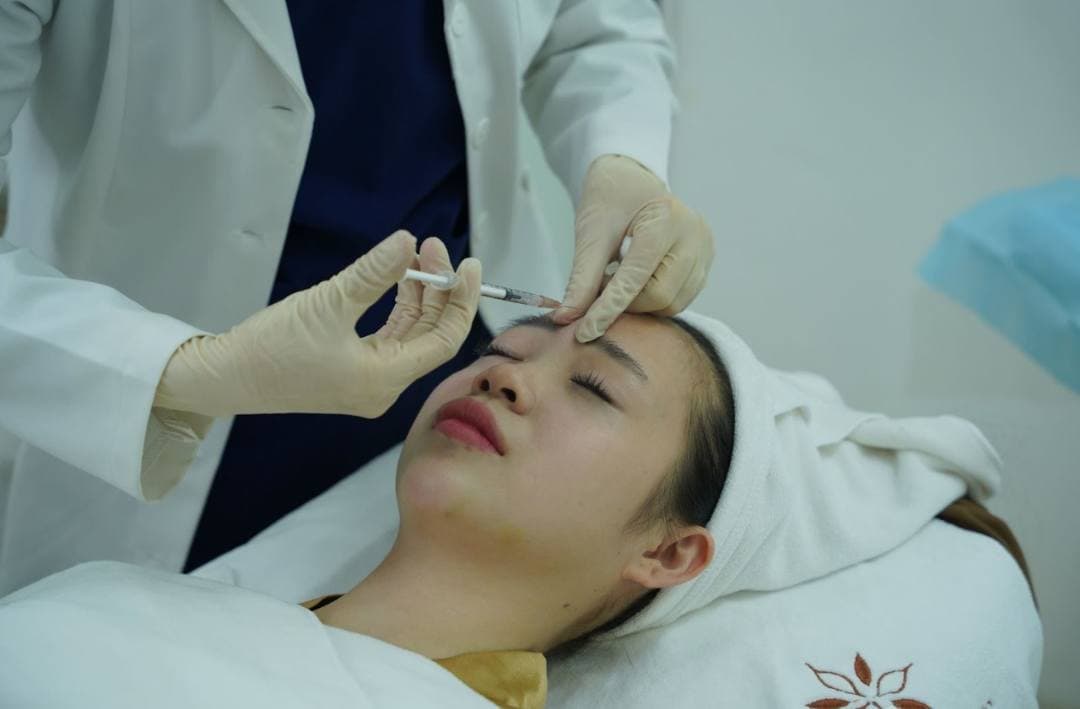
Treatment: Precise points around the eye and glabella are injected personally, protecting the forehead's lifting muscle.
Onset: Most patients begin to notice a change in 3 to 7 days, with the full effect around 2 weeks.
Duration: Results typically last about 3 to 4 months, then fade gradually as movement returns.
Recovery: Essentially no downtime; stay upright, avoid rubbing the area for a few hours, and skip strenuous exercise that day.

Botox and Hooded Eyes, When It Helps, and When It Doesn't
A Botox brow lift can help mild brow and lateral hooding that comes from muscle pull, but it does not remove excess eyelid skin. Whether it will help you depends on how much of the hooding is muscle versus skin, which Sabeen Munib, MD assesses at the consultation.
Muscle-pull hooding (a tired, heavy outer brow with good skin quality): a Botox brow lift may lift the brow tail and open the eye in selected patients.
Skin-excess hooding (significant redundant eyelid skin or true lid ptosis): usually a surgical question such as blepharoplasty, not a Botox one. For functional hooding that affects the field of vision, Dr. Munib will say plainly when surgery is the more appropriate path.
The Risk Patients Ask About: Brow Descent and Eyelid Droop
The risk patients ask about most is brow descent, where the brow drops after treatment instead of lifting. It happens when the frontalis, the only muscle that lifts the brow, is over-relaxed, which is why brow-lift dosing is planned across the whole upper face rather than at the brow alone.
Brow descent and eyelid ptosis are two different things: brow descent is the brow sitting lower from forehead over-treatment, while eyelid ptosis is the upper lid itself drooping from toxin reaching the levator muscle, which is rarer.
What Dr. Munib does to avoid it: conservative frontalis dosing, low and lateral brow-lift points, and a two-week review so any asymmetry can be touched up before it settles. Either outcome, if it occurs, is temporary and resolves as the Botox wears off over 3 to 4 months.

After Your Botox Brow Lift: What to Avoid
A Botox brow lift has essentially no downtime, and most patients return to normal activities the same day.
Stay upright for about four hours and avoid lying face-down, and do not rub, press, or massage the brow and forehead for the first day so the Botox stays in the intended muscles.
Skip strenuous exercise, saunas, and alcohol for the rest of the day to reduce bruising. The lift builds over one to two weeks; if you notice any asymmetry at the two-week mark, return so Dr. Munib can fine-tune it.
Results Timeline
| Stage | When | What happens |
|---|---|---|
| Onset | 3 to 7 days | The brow depressor muscles begin to relax and the brow starts to lift toward its new resting position |
| Full effect | About 2 weeks | The lift is fully visible; a follow-up confirms whether any asymmetry needs a touch-up |
| Duration | 3 to 4 months | Results hold, consistent with other upper-face Botox, then fade gradually as movement returns |
| Re-descent | Varies by patient | In some patients the lateral brow can re-descend before the full effect wears off, so the next appointment can be timed accordingly |
Can a Botox Brow Lift Cause a Droopy Eyelid?
The most common fear about a Botox brow lift is a droopy eyelid, and it is largely avoidable with conservative dosing and accurate placement. True eyelid drooping (eyelid ptosis) is a rare, temporary complication that happens when Botox migrates to the levator muscle that holds the upper lid open, and it is different from the brow descent that can occur when the forehead is over-treated. Sabeen Munib, MD lowers this risk by keeping the brow-lift points low and lateral, dosing the frontalis conservatively, and avoiding heavy injection near the upper orbital rim.
Patients who are not good candidates include those with pre-existing eyelid or brow ptosis, very heavy brow anatomy, or prior upper-lid surgery concerns, because relaxing the wrong muscle in these patients may worsen heaviness rather than relieve it. A Spock brow, where the outer brow peaks too high, comes from uneven lateral elevation and is corrected with a small touch-up at the two-week review. Any temporary asymmetry or heaviness resolves on its own as the Botox wears off over 3 to 4 months.
If the goal is a tail-lift only, a lateral or outer brow lift, sometimes called a cat-eye or fox-eye effect, can elevate just the brow tail in selected patients. Medically reviewed May 2026 by Sabeen Munib, MD.
What a Botox Brow Lift Costs
A Botox brow lift is priced per unit rather than as a flat fee, and the brow lift itself uses only a modest number of units, which makes it one of the smaller Botox treatments by dose. Your total depends on how many units are needed, whether one side or both are treated, and whether the forehead and glabella are co-treated in the same visit to protect the lift.
Because brow position is an upper-face system, most brow-lift plans include some forehead and glabella dosing, and that coordinated dose is what determines the final cost more than the brow points alone. Sabeen Munib, MD confirms the unit count and the estimate at your consultation rather than quoting a fixed package, so the plan matches your anatomy and goals. For a deeper look at how upper-face Botox is priced per unit, see our physician guide to Botox cost.
Combining the Brow Lift with Other Treatments
A Botox brow lift is rarely planned in isolation, because brow position depends on the whole upper face working together. In most patients Sabeen Munib, MD coordinates the brow-lift points with forehead Botox so the frontalis is not over-relaxed, and often with glabella Botox to release the inner-brow depressors that pull the medial brow down.
Crow's feet Botox is frequently added in the same session because the lateral fibers of the orbicularis oculi both create crow's feet and pull the brow tail down, so treating them supports the lift. For brow descent driven by volume loss or bone-structure change rather than muscle pull, a small amount of filler or a PDO thread lift may complement the Botox in selected patients. Whether any of these are added depends on what is actually driving your brow position.
Related Treatments
Related treatments at Spectrum Skin Clinic in Irvine, grouped by how they support a Botox brow lift.
Upper-face Botox that shapes the lift: Forehead Botox softens forehead lines while protecting brow position, Glabella Botox releases the inner-brow depressors behind frown lines and 11s, and crow's feet Botox treats the lateral orbicularis fibers that also pull the brow tail down. Bunny lines Botox is a small-dose complement for nose wrinkles in a full upper-face plan.
Choosing your neuromodulator: explore Dysport as an alternative product for the same brow-lift technique, or read our Dysport vs. Botox comparison if you are weighing the two.
When you may need more than Botox: a PDO thread lift offers a mechanical lift when muscle rebalancing is not enough, and the main Botox overview covers physician-administered Botox across all treatment areas.
Other complements at Spectrum: Masseter Botox for face-balancing dosing across the lower face, and the Botox cost guide for per-unit pricing context.
Book a Botox Brow Lift Consultation in Irvine
Curious whether a Botox brow lift would open up your eyes? Book a consultation with Sabeen Munib, MD at Spectrum Skin Clinic in Irvine. We will assess your brow, set a realistic expectation, and tell you if another approach would serve you better.
Patient Reviews
4.97★ · 441 Patient Reviews

I had an amazing experience with Dr. Munib, who performed my aesthetic treatments including Pico laser, Botox, a glassy facial, Botox for migraine, and HIFU. Every procedure was done with great care, precision, and professionalism, and the results exceeded my expectations. Dr. Munib is incredibly knowledgeable and takes the time to explain everything, making me feel comfortable and confident throughout the process. Her expertise truly shows in her work. The staff was extremely accommodating, friendly, and professional, which made the entire experience even better. On top of that, the prices were very reasonable for the quality of service provided. I highly recommend Dr. Munib to anyone looking for outstanding aesthetic treatments and excellent patient
Mahjabeen Saeed
4 months ago

I had an excellent experience with Dr. Sabeen Munib at Spectrum Skin Clinic in Irvine. I visited her for acne scar treatment and underwent three subcision sessions spaced six weeks apart. Throughout my treatment, I was consistently impressed by her expertise, attention to detail, and compassionate approach. Dr. Munib took the time to carefully evaluate my scars, explain the procedure, and answer all of my questions before starting. During each procedure, she made sure I was comfortable and informed every step of the way. Her technique, skill and experience with acne scar subcision gave me complete confidence that I was in capable hands. The entire team at Spectrum Skin Clinic was professional, friendly, and supportive throughout the process. Although acne scar improvement takes time and healing, I appreciate that Dr. Munib focuses on achieving the best possible long-term results rather than making unrealistic promises. She explained what to expect during recovery and emphasized that collagen remodeling happens gradually. If you're looking for a knowledgeable and caring physician for acne scar treatment or subcision, I highly recommend Dr. Sabeen Munib Spectrum Skin Clinic, Irvine. I truly appreciate the care, professionalism, and dedication I received and would not hesitate to recommend her to anyone seeking advanced scar treatment.
Deepak Jadhav
3 months ago

After several aesthetic nurses told me I was allergic to filler dissolver, Dr. Munib took a careful, evidence-based approach. She used ultrasound to locate my migrated lip filler, tested a small area first, and explained I was reactive—not allergic. She dissolved a small test area before safely treating my upper lip. Throughout the process she was gentle, thorough, and educational. It’s a long drive for me, but her knowledge and expertise make it absolutely worth it.
Jamel Neill
2 months ago

Thank GOD for Dr. Munib. She is the angel of dissolver!!! I had HA nodules and Sculptra nodules from previously going to Dermfx and I went to Dr. Munib for ultrasound guided dissolving. She is gentle, patient, knowledgeable, kind and funny. I feel like she is the last of the good ones in this business. If you are interested in natural looking aesthetic results that aren’t botched and don’t cause you years of facial pain go to her. I would try to see her as my primary doc if I wasn’t moving out of the area. I would travel to go see her though.
Siena Viencek-Walsh
3 months ago
Real Patient Results
All treatments performed personally by Sabeen Munib, MD at Spectrum Skin Clinic, Irvine.
Related Blogs
Personalized Aesthetic & Regenerative Solutions Designed to Heal, Enhance & Restore Naturally





Frequently Asked Questions
Got questions? We’re here to help! Find out what we offer, how to book an appointment, where we’re located, and more. We treat all age groups and offer skincare products too.