

25-50 units/side
15-20 min
2-4 weeks
4-6 months
4.97
Overview
Masseter Botox in Irvine: Jaw Slimming and Bruxism Relief, Physician-Performed
Masseter Botox at Spectrum Skin Clinic relaxes the masseter, the strong jaw muscle that drives clenching and gives the lower face its width, so the jawline softens over the weeks that follow and nighttime grinding eases. It treats three things at once: teeth grinding and jaw tension, TMJ discomfort, and a heavy or square lower-face shape, without surgery and without downtime. Every injection is performed personally by Dr. Sabeen Munib, MD.
The muscle is rarely symmetric. Chewing-side preference and prior dental work leave one masseter larger than the other, so an identical dose to a non-identical pair produces a visibly uneven result. Dr. Munib palpates both sides at rest and at full clench and calibrates each side independently to the individual jaw, not to a preset protocol.
Patients across Irvine and Orange County come to Spectrum for physician-led masseter treatment that separates muscle bulk from jaw bone and from skin laxity before a single unit is placed. That distinction is what decides whether Botox is the right answer or whether the honest recommendation is filler, skin tightening, or a surgical opinion instead.

Who treats you
Why Patients Choose Spectrum Skin Clinic for Masseter Botox
The masseter is the strongest muscle in the head and it sits across the parotid duct, the facial artery, and the risorius branch that lifts the corner of the smile. Injecting too far forward or too superficially can weaken the smile, affect chewing, or accelerate lower-face laxity. Conservative bilateral dosing across the lower third of the muscle is the standard of care, and it is an anatomy decision, not a template.
Dr. Sabeen Munib palpates both sides at rest and at maximum clench before placing any units. She separates true muscle bulk from compensatory hypertrophy, accounts for prior dental work and TMJ findings, and sets a side-specific dose rather than a single number applied to both sides.
Every masseter treatment at Spectrum Skin Clinic is performed by Dr. Munib personally. No delegation, no technician protocol, no spa-style dose templates. Patients searching for masseter or TMJ Botox in Irvine book directly with the physician who treats them, a physician with 15+ years in cosmetic dermatology and aesthetic medicine.
MD
100%
4.97
2 sides
Actual patient · Featured case
Masseter Botox Before and After
Masseter Botox for jaw slimming with TMJ relief, treated personally by Dr. Sabeen Munib, MD at Spectrum Skin Clinic, Irvine.
Read the lower-face width, not the lighting. The jaw angle softens and the lower third narrows as the muscle reduces, while the patient keeps a full, natural smile. Slimming comes from muscle change over weeks, not from a same-day effect.
See All Results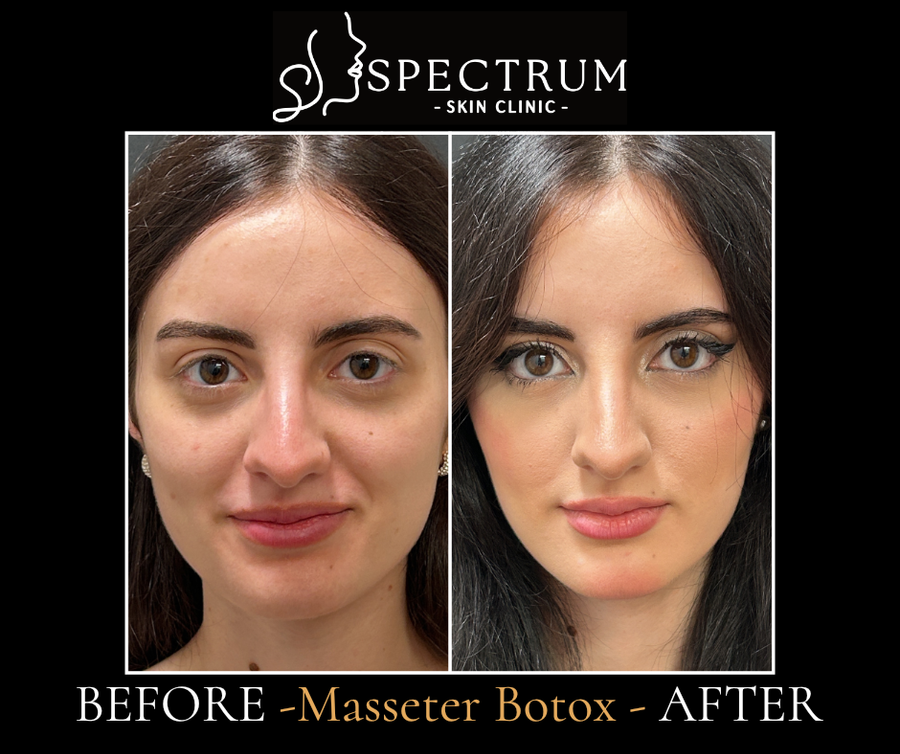
Technique
How the Masseter Dose Is Planned
Masseter Botox is not one fixed number of units. Dr. Munib sets four things per treatment, in sequence, so the dose fits the individual jaw and the smile is protected.
Bilateral palpation
Separates true muscle bulk from bone width and skin laxity, and grades each side.
Safe-quadrant mapping
Keeps injections away from the smile muscles, the parotid duct, and the facial artery.
Side-specific dosing
Corrects a non-identical muscle pair toward a balanced, proportionate result.
Six-week review
Adds units only where needed and keeps the cumulative dose conservative over years.
25-50 units per side
50 to 100 units total depending on muscle volume and goals. First-time patients are usually started at the lower end with a six-week recheck.
Before & After
Masseter Botox Before and After: Real Patient Results
Every result below was treated personally by Dr. Sabeen Munib at Spectrum Skin Clinic, Irvine. Each opens the full case.
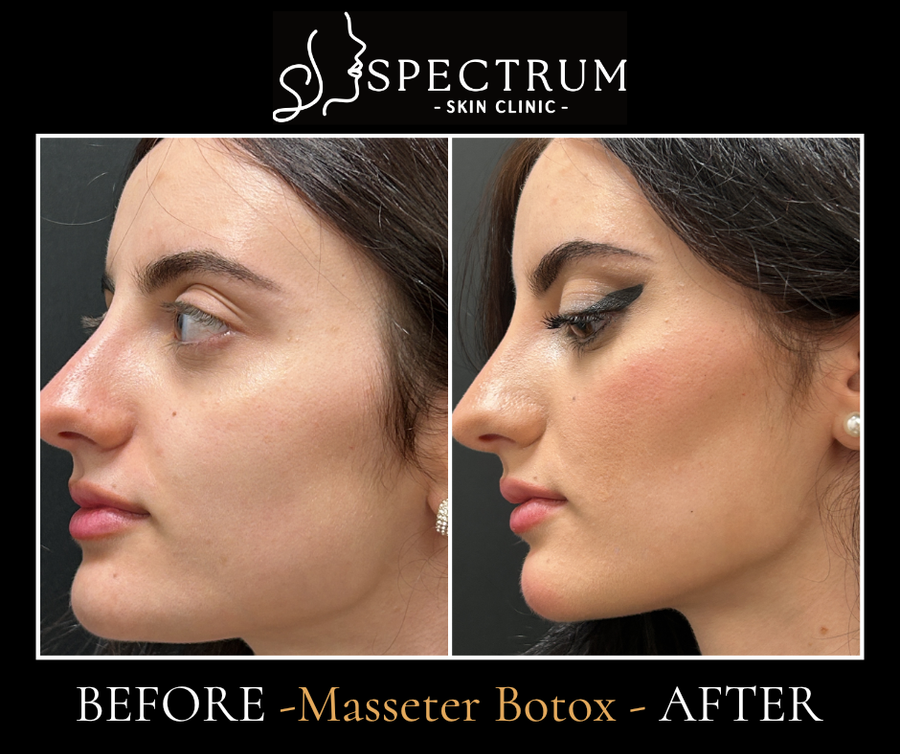
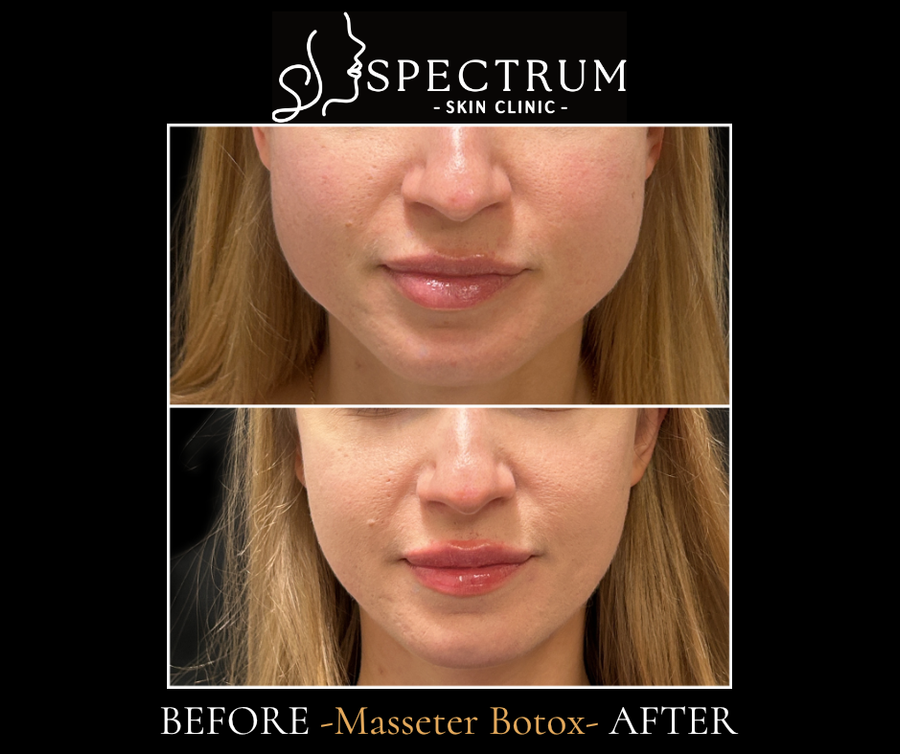
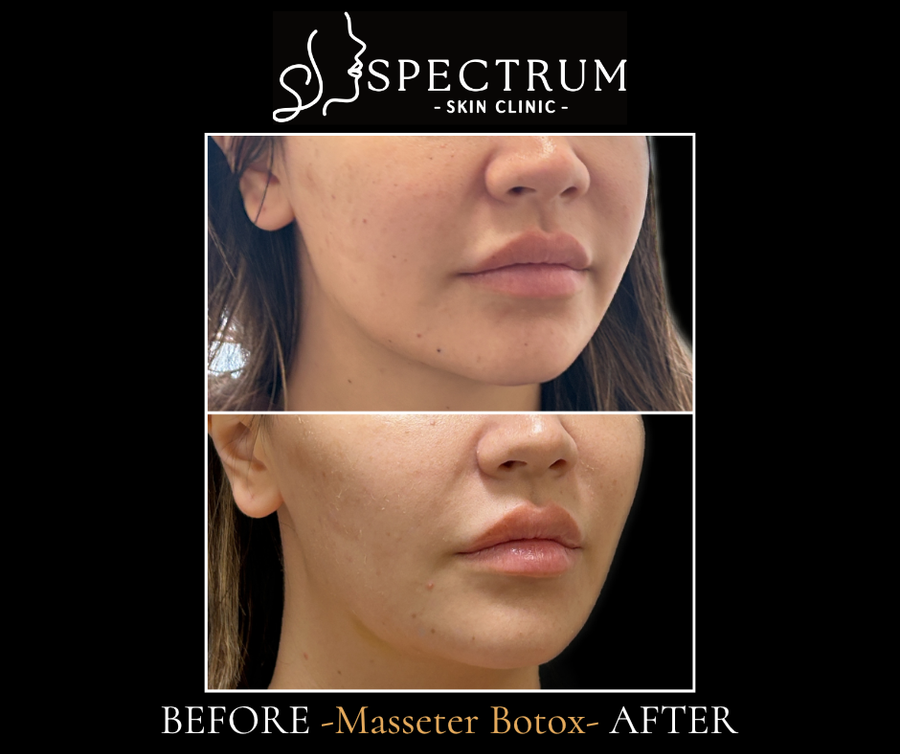
How Masseter Botox Works
Masseter Botox temporarily blocks the chemical signal from the trigeminal motor branch to the muscle. After precise micro-injections across the muscle bulk, the toxin binds the nerve terminal and prevents the release of acetylcholine. Without that signal, contraction force drops over 4 to 8 weeks.
As contraction decreases, the muscle reduces in volume, a process called disuse atrophy. The lower face narrows and clenching force eases. The effect reaches full intensity around weeks 6 to 8 and lasts 4 to 6 months. The toxin then breaks down naturally and the nerve terminals regenerate, which is why conservative re-treatment intervals matter: they keep the cumulative dose low and reduce the risk of resistance over many years.
For patients who grind or clench, the same signal block that slims the jaw is what relieves the symptom. A masseter that cannot contract with full force stops driving the nighttime grind, so morning jaw soreness and tension headaches typically ease within one to two weeks, before the visible slimming appears.
Why Placement Precision Matters
The masseter sits next to the risorius and the lower fibers of the zygomaticus major, both of which carry the smile, and the parotid duct and facial artery run across its surface. An injection placed too far forward or too superficially can briefly weaken the smile on the treated side or produce a temporary asymmetry that resolves only as the toxin wears off. Staying posterior and inferior, below the parotid duct, is what protects the smile.
Dose matters as much as placement. An aggressive first dose may slim faster, but it also raises the risk of an over-hollowed jaw, faster jowl visibility in patients who already have lower-face laxity, and a longer recovery if the dose drifts downward. A conservative first dose with a six-to-eight-week review is the safer path for a new masseter patient.
Is this the right tool?
Masseter Botox vs Filler vs Tightening vs Surgery: Which Fits Which Jaw
Not every wide or heavy lower face is a muscle problem. This is how Dr. Munib sorts them at consultation.
Treatment planning
Combined Approaches
Candidacy
Who May Be a Candidate
Masseter Botox may suit you if you grind or clench your teeth, wake with jaw tension or tension headaches, have TMJ discomfort, want a slimmer and more oval lower face without surgery, or have enlarged masseters from habitual clenching. Every treatment begins with a physician consultation to assess your jaw anatomy and build a plan.
Whether it is the right tool depends on what is driving the shape and the symptom. Muscle responds to Botox; bone and lax skin do not. That is why the consultation separates the three before any units are placed.
How Dr. Munib decides
Bilateral palpation at rest and on clench, a smile-video review to protect the smile muscles, an assessment of bite-force needs and TMJ history, and a check for skin laxity where muscle reduction could unmask a jowl. The dose is then set per side rather than as one number.
Good fit
Teeth grinding or clenching, jaw tension or TMJ discomfort, and a wide or square lower face from muscle bulk, in a patient who wants a non-surgical option and can wait weeks for the change to build.
Usually not the right tool
Lower-face width that is mainly bone, or significant skin laxity where reducing the masseter may accelerate jowl visibility. Pregnancy and breastfeeding defer treatment, and patients with myasthenia gravis, Lambert-Eaton syndrome, or ALS are referred to their neurologist before any neuromodulator.
Recovery
What to Expect & Timeline
Onset begins at weeks 2 to 4 and full slimming appears by weeks 6 to 8. Symptom relief from clenching usually comes first. Results last 4 to 6 months for first-time patients and longer with maintenance.
Informed consent
Documented Risks of Masseter Botox
Searches for masseter Botox gone wrong surface a small set of recurring complications. Naming them, and the anatomical reason each happens, is more useful than reassurance. All of the effects below are temporary and resolve as the toxin wears off over 3 to 6 months, but the interval is real and worth understanding before consent.
Smile distortion or asymmetric smile
The masseter sits next to the risorius and the lower fibers of the zygomaticus major. An injection placed too far forward, too superficially, or diffusing across an unmapped plane can briefly weaken the muscles that lift the corner of the mouth, flattening or pulling down the smile on one or both sides. The risk is highest in thin masseters and slim faces. Bilateral palpation, marking the anterior border on contraction, and staying in the posterior-inferior quadrant reduce, though never eliminate, this risk.
Chewing fatigue with firm food
The masseter is one of four chewing muscles. Even a full masseter dose leaves the temporalis and the pterygoids working, so most patients chew normally within days. A subset, usually high first-time doses or thin baseline muscle, describe fatigue with steak, raw apple, or chewy bread for the first few weeks, which eases as the other muscles compensate. Significant dental or TMJ history should be disclosed so the dose can be adjusted.
Paradoxical sagging or a new jowl
The masseter lends a little structural support to the overlying skin. In patients who already have skin laxity, midface volume loss, or fat-pad descent, aggressive reduction can unmask a jowl that was already forming. This is one of the most common reasons to decline masseter Botox in selected patients. Where laxity is the dominant concern, skin tightening or a surgical opinion is the right entry point, not muscle reduction.
Visible asymmetry between the two sides
Right and left masseters are rarely identical, and chewing-side preference and prior dental work widen the gap. An identical dose to a non-identical pair produces a visibly uneven result. Palpation at rest and on clench, photo documentation, and side-specific dosing prevent this. Patients with marked baseline asymmetry are counseled that proportionate reduction, not perfect symmetry, is the goal.
Underwhelming or no visible change
The most common reason a patient feels it did not work is that the lower-face width was from jaw bone, not muscle, and bone does not respond to neurotoxin. Careful palpation at consultation distinguishes the two. A smaller group have anti-botulinum antibodies that reduce response over time, where switching formulation may help.
Honest consent names the wear-off interval of 3 to 6 months. A patient who understands the half-life can wait a temporary effect out. A patient promised a painless, permanent result is the one who feels deceived when something temporary happens.
Safety and Who May Not Be a Candidate
Masseter Botox is avoided in pregnancy and is generally deferred while breastfeeding. Patients with active myasthenia gravis, Lambert-Eaton syndrome, or ALS are not candidates at standard aesthetic doses and are referred to the treating neurologist before any neuromodulator is considered.
Patients whose work depends on full chewing or jaw strength, certain singers, brass players, and athletes, are better served by a conservative dose or a different approach. Bite-force needs are weighed at the consultation, along with whether significant skin laxity makes bulk reduction the wrong first step.
Aftercare & Recovery
Pricing
What Affects Your Cost
Masseter Botox is priced per unit. A treatment typically uses 25 to 50 units per side, or 50 to 100 units total, depending on muscle bulk and treatment goals. Dr. Munib confirms the per-unit rate and a written estimate at the consultation, after bilateral palpation.
Your total depends on the units needed across both sides, the dosing strategy chosen at consultation, and whether the plan combines another area such as a Nefertiti Lift or chin Botox in the same visit.
First-time patients are usually started at the lower end of the dose range with a six-week recheck before any additional units are placed, which keeps the first-visit cost conservative while the response is confirmed.
Pay monthly with


Results
Will My Jaw Look Overdone or Sunken?
Done well, masseter Botox looks like a softer, more oval lower face, not a hollowed one. The goal is proportionate reduction of an over-strong muscle, which is why the first dose is conservative and reviewed at six weeks rather than pushed for a fast, dramatic change.
Chewing function is preserved at clinical doses. The masseter is reduced in clenching force, not in everyday voluntary contraction, so most patients eat normally within days. The change most bruxism patients describe is relief, less morning soreness and fewer tension headaches, rather than any loss of function.
The over-hollowed jaw people worry about comes from an aggressive dose on a thin muscle, or from reducing a masseter that was supporting lax skin. Both are exactly what the bilateral assessment is designed to catch, which is why Dr. Munib will sometimes recommend against treatment rather than proceed.
Explore
Related Treatments
Botox
The Botox overview, if you want the neuromodulator explained across every treatment area before focusing on the jaw.
Nefertiti Lift (Neck Botox)
Treats the platysmal bands for a sharper jaw-neck transition, often paired with masseter for the full lower face.
Trap Botox (TrapTox)
Slims the trapezius for a longer neckline when the goal extends past the jaw.
Chin Botox (Mentalis)
Relaxes a hyperactive mentalis when the lower-face pattern includes chin dimpling.
Lip Flip with Botox
A subtle upper-lip enhancement for patients balancing the whole lower face.
Dysport Injections
An alternative botulinum toxin selected at consultation when its diffusion profile fits the patient better.
Patient reviews
What Patients Say
4.97★ across 441 verified Boulevard patient reviews.

Mahjabeen Saeed

Deepak Jadhav

Jamel Neill


Questions
Frequently Asked Questions
Masseter Botox is priced per unit. A treatment typically uses 50 to 100 units total across both sides depending on muscle bulk and goals. The per-unit rate and a written estimate are provided at the in-person consultation after bilateral palpation.
Yes. By reducing the clenching force of the masseter, it commonly eases jaw tension, morning soreness, and grinding. Symptom relief usually appears within 1 to 2 weeks, before the visible slimming develops.
Typically 25 to 50 units per side depending on muscle size and the desired reduction. It is assessed by palpation at consultation, not a fixed dose applied to everyone.
About 4 to 6 months for first-time patients. With regular maintenance, the masseter reduces progressively and results last longer between treatments.
Tension and pain relief typically appear within 1 to 2 weeks. The visible slimming develops over 6 to 8 weeks as the muscle gradually reduces in volume.
Slightly, in the first 2 to 4 weeks as the muscle adjusts. Normal eating is not significantly affected because the other chewing muscles keep working.
It depends on existing skin laxity, baseline muscle bulk, and how much reduction is targeted. In patients with significant laxity, conservative dosing limits the risk. The bilateral evaluation at consultation includes this assessment and the dose is calibrated accordingly.
Yes, when performed by an experienced physician with precise anatomical placement. Dr. Munib's placement stays away from the smile muscles, the parotid duct, and the facial artery.
Yes, it is commonly combined with a Nefertiti Lift, chin Botox, forehead Botox, or crow's feet in the same appointment.