
24–48 hours
1–2 days
About 2 weeks
One or more
Overview
Ultrasound-Guided Filler Dissolving, Performed by Sabeen Munib, MD
Sabeen Munib, MD dissolves hyaluronic acid filler at Spectrum Skin Clinic in Irvine, and she performs every dissolve herself under ultrasound guidance. Patients come from Newport Beach and across Orange County with lip, under-eye and facial filler that has moved, lumped or overfilled. You can book a $150 physician evaluation for filler placed elsewhere, or a $65 aesthetic consultation, through Book Now or at (949) 259-4790.
Dissolving filler, removing unwanted filler and correcting botched filler describe the same procedure. A prescription enzyme, hyaluronidase, is placed into hyaluronic acid gel, and the gel breaks down where the enzyme reaches it. Hyaluronic acid filler placed for lip injections, facial contouring, the facial folds or an under-eye hollow responds to that same enzyme.
The site changes the depth and the thickness of skin over the product. The chemistry does not.
Filler that has migrated, sits more superficially than intended, or has built up over several rounds is a common reason for reassessment. A lip ledge, a puffy lower eyelid or a heavy midface can often improve once the product underneath has been located. Imaging identifies the hyaluronic acid filler before any hyaluronidase is placed, and treatment is directed at that product rather than the tissue around it.
For under-eye concerns, see what ultrasound-guided under-eye filler dissolving involves. Our guide covers what filler dissolving involves in Orange County.

The Spectrum approach
Why Patients Travel to Spectrum for Filler Correction
Filler placed at another clinic may arrive without records of the product, the depth or the number of rounds. Assessment starts with ultrasound and a history of what was placed and when. Together, those two narrow down what is likely present before anything is offered.
Sabeen Munib, MD personally performs every filler dissolution at Spectrum Skin Clinic, and no injection is delegated or outsourced. She assesses what product is present, where it sits, and what the anatomy underneath should look like. Dr. Munib regularly handles botched filler corrections and filler removal for work placed by other providers, including for patients travelling from Newport Beach, Laguna Hills, Mission Viejo and Los Angeles.
Treatment is staged deliberately. Preserving native volume is what most patients are most worried about losing, and a conservative first pass leaves room for a second visit. Removing too much in one session cannot be taken back the same day.
A staged dissolve leaves correctly placed filler in the face while misplaced product softens. The approach removes what imaging finds out of place and keeps what still fits the anatomy.
Personally performed
Imaging first
Staged dosing
Informed consent
Before & After
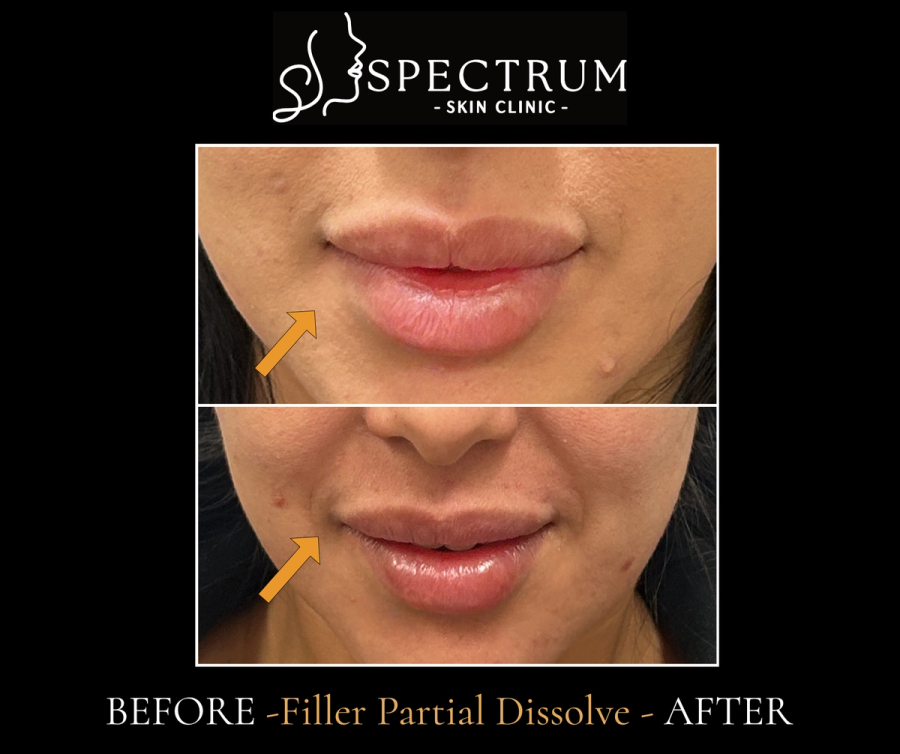
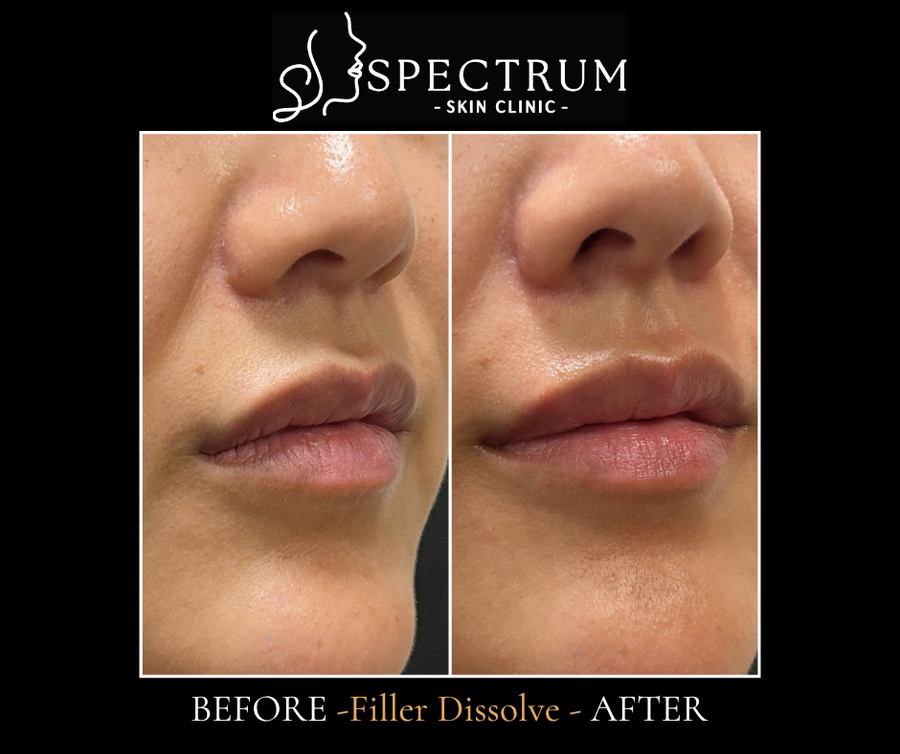
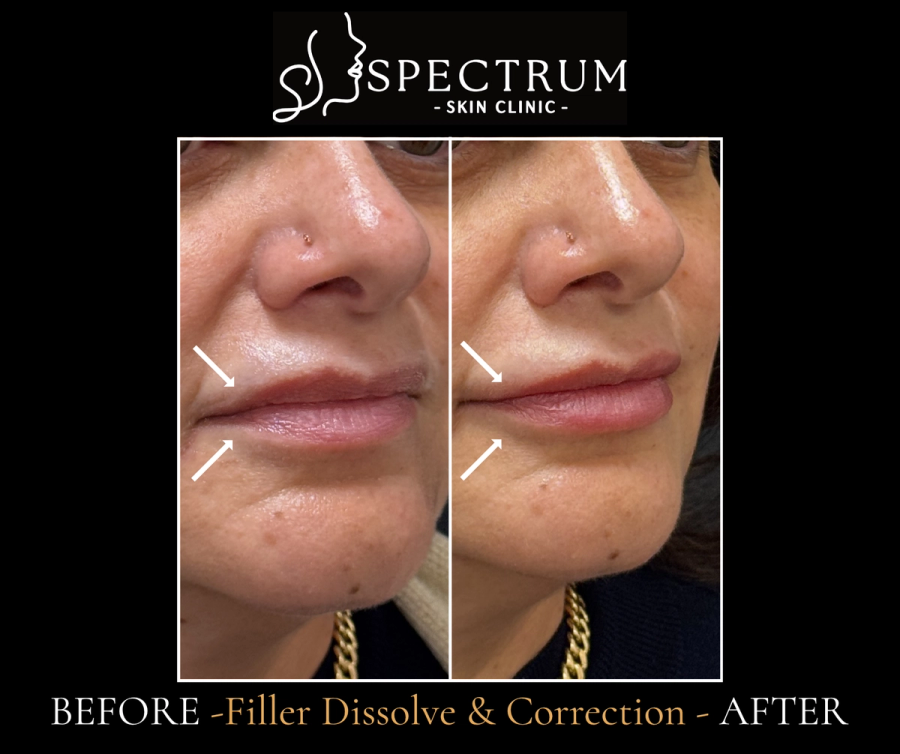
Filler Dissolve Before and After
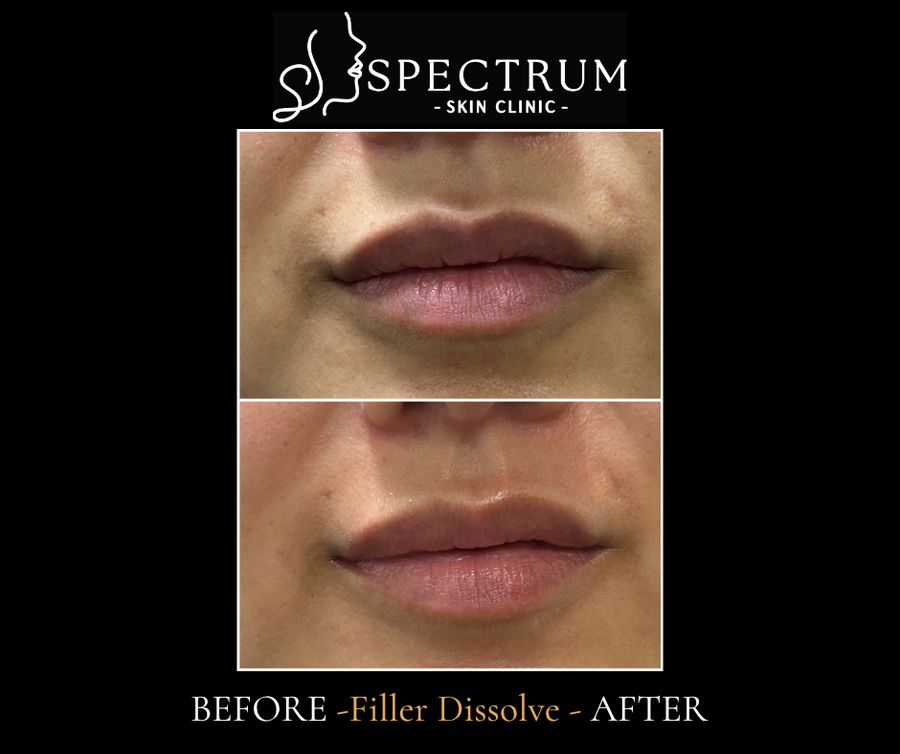
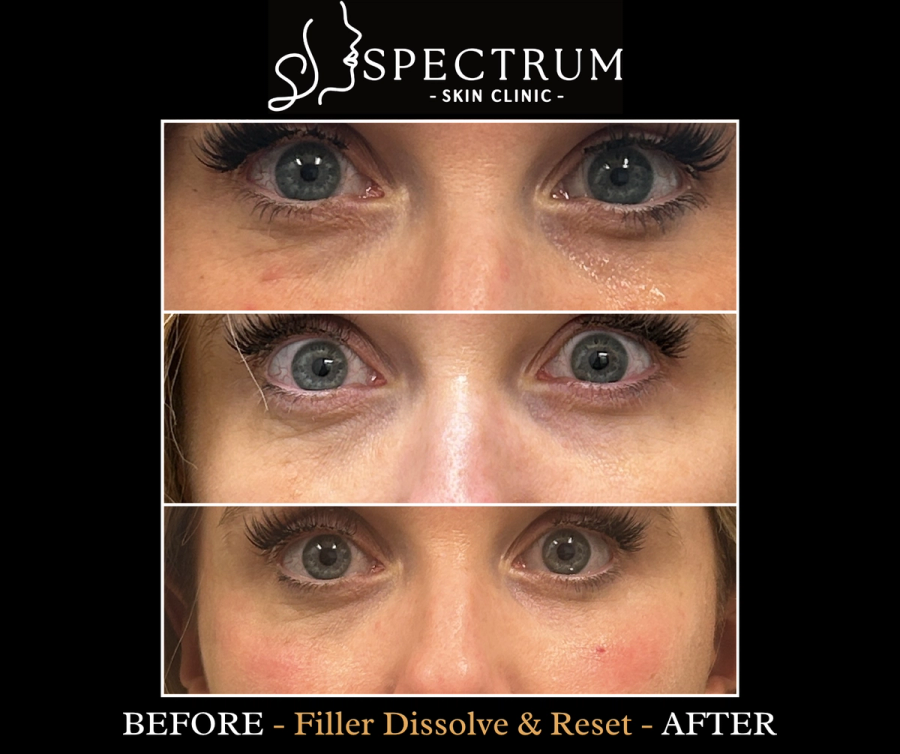
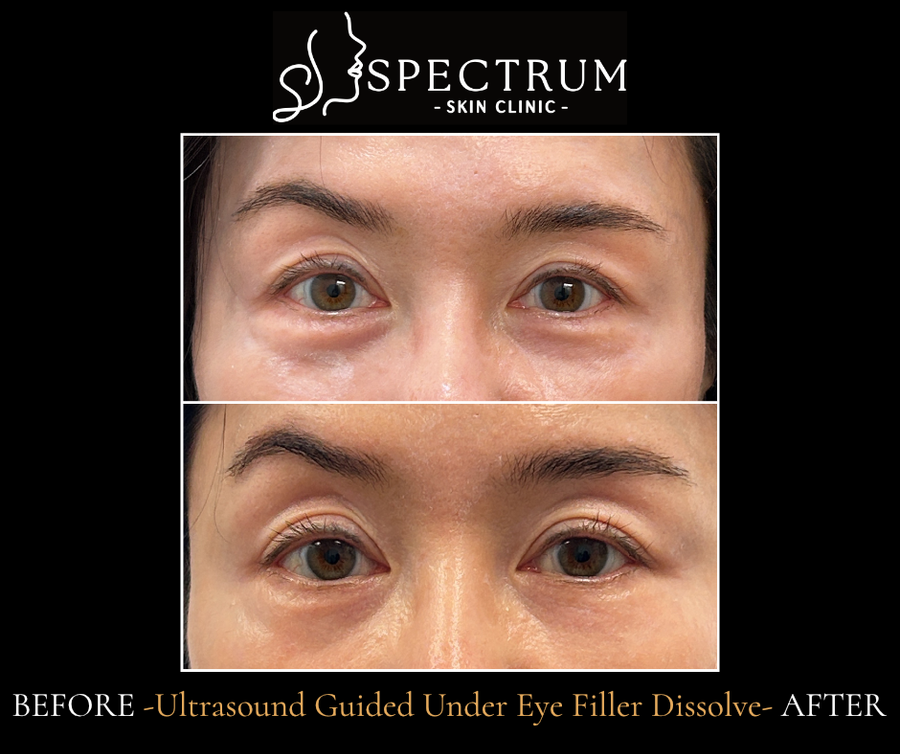
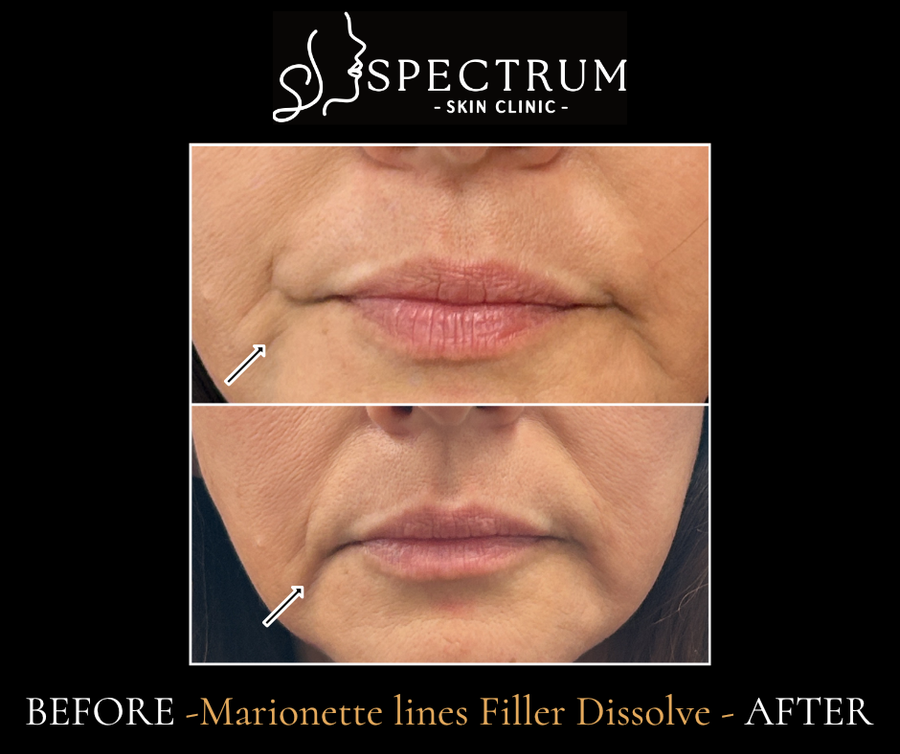
These pictures are real Spectrum Skin Clinic patients, each treated personally by Sabeen Munib, MD. Each case shows one site: a lip ledge, a tear trough, a full reset, the marionette lines, or the chin and nasolabial folds.
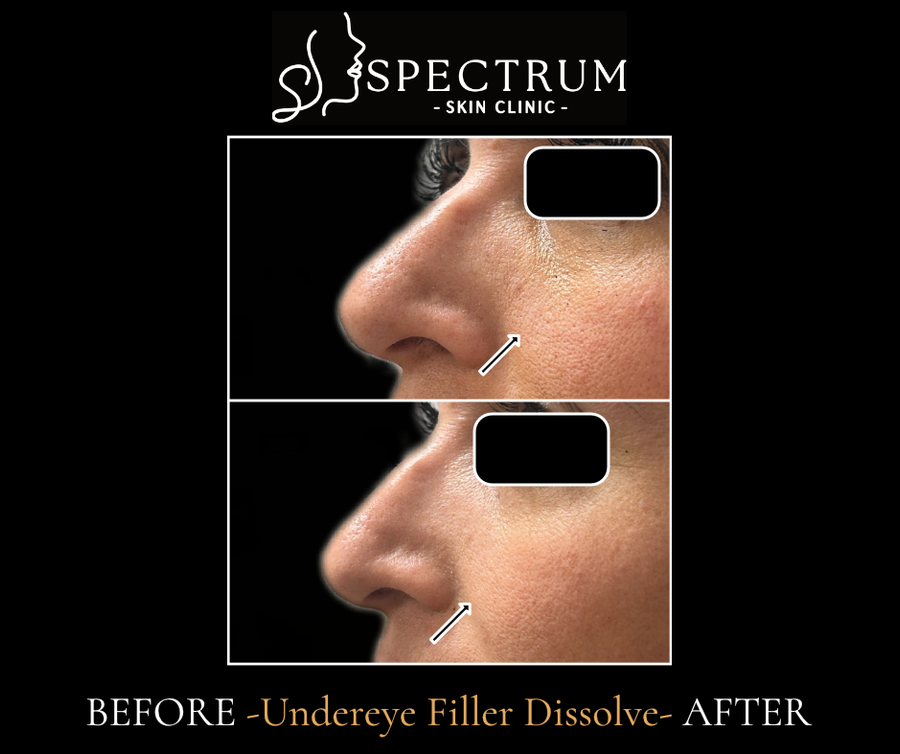
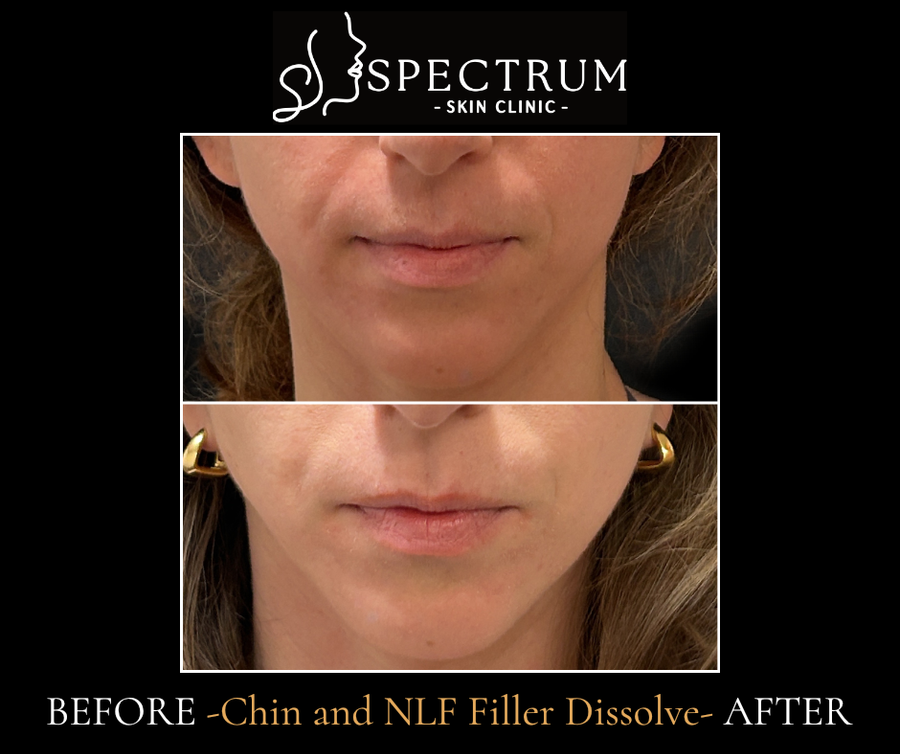
How Hyaluronidase Dissolves Filler
Hyaluronidase is an enzyme that breaks down hyaluronic acid. Most modern dermal fillers are hyaluronic acid gels, and those products may be dissolvable when correction is appropriate. The dissolver used at Spectrum is brand-name Hylenex recombinant, a prescription medication administered by a physician.
The enzyme acts only on the filler it reaches. Placement matters more than quantity, and the skin's own hyaluronic acid can be affected as well. For that reason hyaluronidase goes into mapped deposits instead of being spread across a whole lip or cheek.
Using hyaluronidase to dissolve dermal filler is an off-label aesthetic use. It is well established in aesthetic practice, but it sits outside the product's approved indications. A prior reaction to hyaluronidase is reviewed before treatment, and it is not appropriate for every patient.
At the lip line, a staged dissolve can soften gel that migrated past the vermilion border while correctly placed volume stays. The principle is to treat the product that imaging finds, and nothing around it.
Why the Filler Is Mapped First
Ultrasound shows where filler sits, how deep it lies, and whether it has moved from where it was injected. A handheld probe maps the deposits at consultation, and the same imaging guides the needle into them during treatment.
Without imaging, placement is an estimate. Filler that has migrated can sit away from the point where it was injected, and hyaluronidase placed at that point may miss it entirely.
No hyaluronidase is injected until you have reviewed the map together with Dr. Munib.
Which finding responds
Lip Ledge vs Under-Eye Tint vs Lumps: What Hyaluronidase Can Reach
Each finding has a physical cause, and the cause decides whether the enzyme can reach it.
Combined approaches
What Can Follow a Dissolve
Who may be a candidate
Filler dissolving may be appropriate when previous hyaluronic acid filler has moved, lumped or built up over time. A puffy ridge above the lip line, sometimes called a filler mustache, usually reflects gel that has spread past the vermilion border.
Firm beads or cords that were not there right after injection are another finding imaging can clarify. So are under-eyes that look puffy or bluish-grey in certain light, where concealer does not hide the tint.
You may have noticed friends or family saying you look different, or you may avoid certain photos. Years of top-ups from different injectors can leave the face heavier and less defined. Some patients want a full reset before deciding what, if anything, to add back.
How Dr. Munib decides
Ultrasound shows the product, its depth and whether it has moved from the injection site. The history fills in what was placed, by whom and when. Candidacy is confirmed only after that map has been reviewed with you. A dissolve is offered only when the evaluation shows it is the right step.
Often a good fit
Hyaluronic acid filler that has migrated in the lips, under the eyes or in the cheeks. Visible bumps, puffiness or a bluish tint from filler placed too superficially. Tear trough filler that needs a precise, staged correction. Accumulated product from several providers, where clearing it first can make the next result easier to judge.
Where dissolving does less
Biostimulators and permanent or semi-permanent fillers do not respond to hyaluronidase, and dissolving is not offered for them. Their management depends on the specific product, and a physician evaluation may end in coordinated care or referral. Filler that has been in the tissue for a long time may improve only partially. A small number of findings are better left to resorb on their own, and a history of reaction to hyaluronidase may rule it out.
What to expect
From Consultation to Recovery
Under-eye work is more sensitive than cheek or jawline treatment. Timing varies with the filler type, its depth and how long it has been in place.
Documented risks
Risks and Warning Signs
Hyaluronidase is a prescription enzyme, and its risks are reviewed with Dr. Munib before anything is injected.
Allergic reaction
A prior reaction to hyaluronidase is reviewed before treatment. A history of allergy to hyaluronidase may mean dissolving is not appropriate.
Swelling
Mild swelling for 24–48 hours is common. It can mask the result at first, and results are assessed after about two weeks. Long-standing filler may improve only partially, and some patients need multiple sessions.
Effect on native tissue
The enzyme can act on the skin's own hyaluronic acid as well as on filler. Placing it into mapped deposits and staging the dose is intended to limit that effect.
Partial correction
Long-standing filler may improve only partially, and some patients need more than one session. That is assessed at follow-up, not promised in advance.
Consent covers the off-label use of hyaluronidase, your allergy history, the possibility of partial correction and the chance of a second visit. It is reviewed with Dr. Munib as part of the clinical decision, before any hyaluronidase is placed.
Blood flow after filler
Injection into a blood vessel is the most serious risk of dermal filler. A color change or pain after filler can signal restricted blood flow, and it needs prompt medical care.
If you notice either after filler from any clinic, seek medical care promptly rather than waiting for a scheduled visit. You can reach us at (949) 259-4790.
Evaluation decides what falls within the practice's scope. When a finding falls outside it, care is coordinated with your primary care physician or you are referred to the right specialist.
Aftercare & Recovery
Cost
What Affects the Cost of Filler Dissolving
A dissolve is quoted at consultation, once imaging shows how much product is present and where it sits.
We offer two evaluations. The $150 physician evaluation is for filler placed elsewhere, a suspected complication or a second opinion. The $65 aesthetic consultation is for a routine assessment. Booking an evaluation does not commit you to treatment.
The new-patient offer on first treatments does not apply to filler dissolve.
Pay monthly with


Will this look natural?
Will Dissolving Leave My Face Hollow?
Losing volume that still looks right is the fear most patients bring to this appointment. Native hyaluronic acid in the skin can be affected by hyaluronidase. That is why the dose goes into mapped deposits and is staged across visits when needed.
A conservative first visit leaves correctly placed filler where it sits wherever possible. A second visit is considered only after the tissue has settled, at about two weeks. If you later want filler added back, that is a separate decision made on a settled face.
The principle is to remove less and look again, rather than remove too much at once.
More real cases are in our before and after gallery.
Explore
Related Treatments
Lip Filler Dissolve
For a migrated, overfilled or unbalanced upper or lower lip, with the vermilion border mapped before any hyaluronidase is placed.
Under-Eye Filler Dissolve
For puffiness, a bluish tint or migration in the tear trough, where the skin is the thinnest on the face.
Nasolabial Fold Filler Dissolve
For overfilled smile lines and midface heaviness from filler in the nasolabial folds.
Filler Lumps & Nodules Dissolve
For palpable lumps, nodules, irregularities or delayed-onset reactions from prior filler.
Cheek Filler Dissolve
For overfilled, heavy or migrated cheek filler.
Chin Filler Dissolve
For overprojected, lumpy or migrated chin filler.
Jawline Filler Dissolve
For overfilled, heavy or migrated jawline filler.
Migrated / Botched Filler Correction
When a botched result looks asymmetric or unnatural across more than one site, evaluation decides what can be corrected and what needs referral.
Lip Filler
For fresh lip filler once a dissolve has settled, physician-performed with a cannula technique.
Sculptra
To restore volume after a full reset with a collagen biostimulator, which hyaluronidase does not reverse.
Patient reviews
What Patients Say
4.97★ across 441 verified Boulevard patient reviews.

Staci Sitorius

Dina Naziri

Ahmad Niazi

Questions
Frequently Asked Questions
Mild discomfort similar to a blood draw. Topical anesthetic available on request. Most patients do not require it. Pain depends on the area being treated, under-eye work is more sensitive than cheek or jawline. Learn what to expect in Under-Eye Filler Dissolve
Hyaluronidase begins acting on hyaluronic acid filler quickly, and early change is often noticeable within one to two days. Swelling in the first 48 hours can mask the result, so the outcome is usually assessed about two weeks later once tissue has settled. How complete the change is depends on the filler type, its depth, and how long it has been in place.
Filler dissolving uses hyaluronidase, an enzyme that breaks down hyaluronic acid (HA) dermal filler. It is used to correct overfilled, lumpy, asymmetric, or migrated HA filler. At Spectrum Skin Clinic in Irvine, Sabeen Munib, MD performs dissolving with ultrasound guidance so the product is located before any enzyme is placed.
Ultrasound imaging shows where filler sits, how deep it is, and whether it has migrated from where it was originally injected. Dr. Munib uses that map to place hyaluronidase into the targeted product, dissolving the problem filler while leaving surrounding tissue alone.
Common areas include the lips, under-eyes (tear trough), cheeks, chin, nasolabial folds, and jawline, as well as filler lumps and nodules anywhere on the face. Each area has its own anatomy, which is why imaging is used before treatment.
No. Only hyaluronic acid (HA) fillers respond to hyaluronidase. Biostimulators such as Sculptra and Radiesse, and any permanent or semi-permanent fillers, cannot be dissolved this way, management of those products depends on the specific filler used. Where the previously injected product is not known, imaging and history are used to narrow down what is likely present before dissolving is offered.
HA filler can be dissolved at almost any time after it is placed. For swelling versus true overfill, it can help to wait until initial swelling settles so the assessment reflects the actual result; the right timing depends on the situation and is discussed at consultation.
In appropriately selected patients, filler dissolving is a well-established procedure. A history of allergy to hyaluronidase is reviewed beforehand, and at Spectrum Skin Clinic it is performed by a physician with ultrasound guidance. Whether it is appropriate for you depends on the filler type, location, and your medical history.
Spectrum Skin Clinic offers ultrasound-guided filler dissolving in Irvine and serves patients across Orange County, including Newport Beach, Tustin, Costa Mesa, and Laguna Hills. Sabeen Munib, MD maps the filler under ultrasound before dissolving, so correction is targeted rather than guesswork. Call (949) 259-4790.
Hyaluronic acid filler breaks down slowly on its own over time, at a pace that depends on the product and where it was placed. Filler that has moved, formed lumps or built up over years of top-ups may not settle by itself, which is when dissolving is considered. Sabeen Munib, MD uses ultrasound to see what is still present before recommending anything.
Yes. Filler can move from where it was placed, most often in the lips, under-eyes or cheeks, and a ledge above the lip line is a common sign. If the migrated product is hyaluronic acid filler, it can usually be dissolved with hyaluronidase. Ultrasound shows where it sits now, so the enzyme goes into the migrated filler and not the surrounding tissue.
Dissolving removes the filler the enzyme reaches, and the skin's own hyaluronic acid can be affected too. That is why Dr. Munib places the enzyme into mapped deposits and stages treatment, leaving correctly placed filler where possible. The result is judged at about two weeks, once swelling has settled, before anything else is decided.
New filler is considered only once the tissue has settled, which is assessed at about two weeks after a dissolve. Adding filler back is a separate decision, made on a settled face with Dr. Munib.
Sabeen Munib, MD personally performs every filler dissolve at Spectrum Skin Clinic in Irvine, using ultrasound to locate the filler before any enzyme is placed. No injection is delegated.