
At rest and on animation
Day 3 to 7
Days 1 to 7
Weeks 4 to 12
None to about a week
Overview
Fine Lines and Wrinkles in Irvine
Most patients arrive asking which treatment removes their lines. The more useful question is why the lines are there, because four different processes produce marks that look similar in a mirror.
A line caused by muscle movement, a line etched into thinned collagen, a fold cast by lost volume and a crease running through lax skin are four separate problems. They respond to different tools. Treating one as though it were another is the most common reason a patient spends money and is disappointed with the result.
Dr. Sabeen Munib, MD assesses which of these is driving your lines before discussing any device or injectable. In many faces more than one is present at once, and the sequence in which they are addressed matters as much as the choice itself.

Who treats you
Why the Assessment Matters More Than the Device
Most clinics in Orange County own similar equipment. What differs is whether anyone works out which cause is producing your lines before choosing from it.
Dr. Sabeen Munib, MD has practiced cosmetic dermatology in the Irvine area for over fifteen years. Injectable, laser and energy-based treatment is performed by her rather than delegated, and the assessment that decides the plan is done by the same person who carries it out.
100%
15+
4
One case, read closely
Etched Lines, Treated as Structure
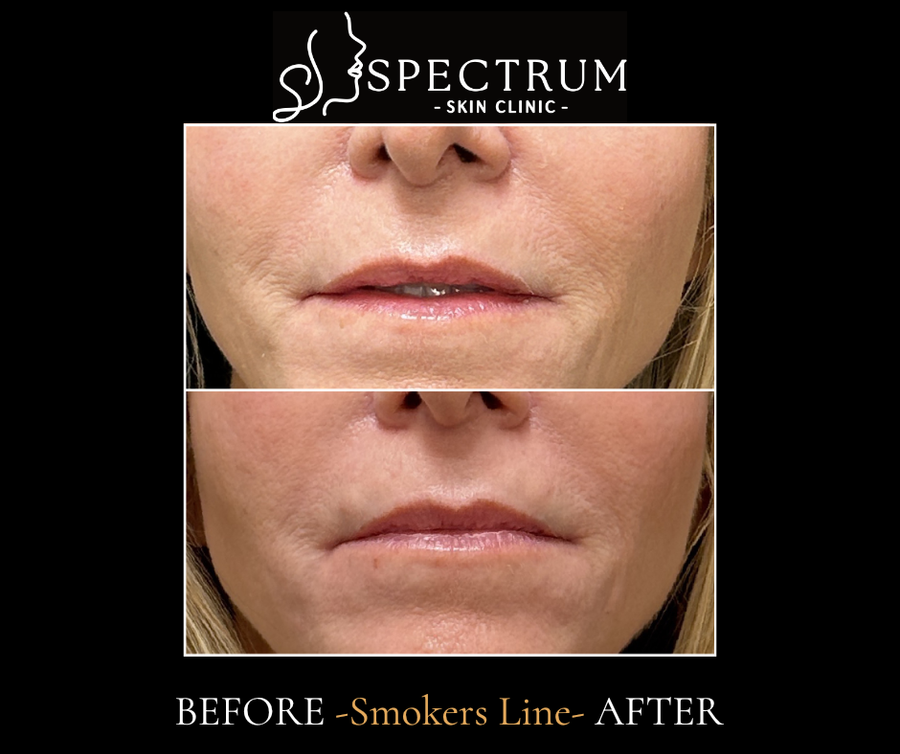
Perioral line resurfacing with fractional CO2. Treated by Dr. Sabeen Munib, MD.
Look at the vertical lines on the upper lip rather than the whole face. These were present at rest, which places them in the structural category. A neuromodulator would have done very little here, and heavy dosing around the mouth risks affecting speech and expression. Resurfacing was the relevant tool because the problem sat in the skin, not the muscle.
See All Results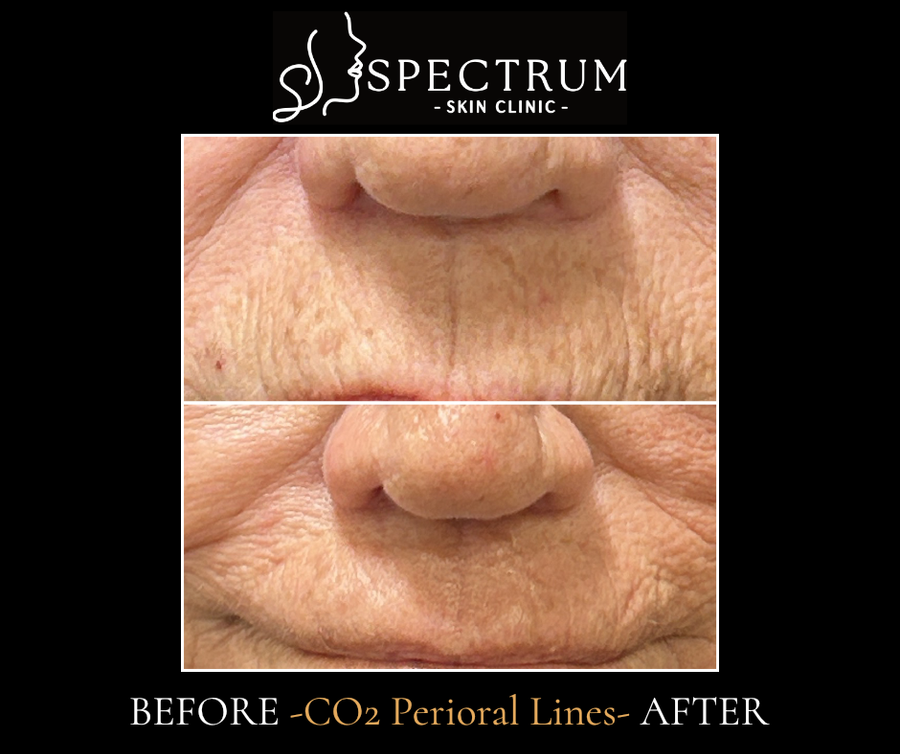
By area
Where Lines Appear, and What Each Area Responds To
Different zones age differently. The upper face is mostly movement. The lower face is mostly volume and skin quality.
Forehead and frown lines
Reduce the movement that creates the fold
Crow's feet
Soften the fan of lines at the outer eye
Perioral and smoker's lines
Refine fine vertical lines on the upper lip
Nasolabial folds and marionette lines
Restore the support the fold is falling over
Neck, chest and under-eye crepe
Improve skin quality and firmness
In person, before any plan
Photographs at rest and on animation are taken so change can be judged against a baseline rather than memory
Real patients
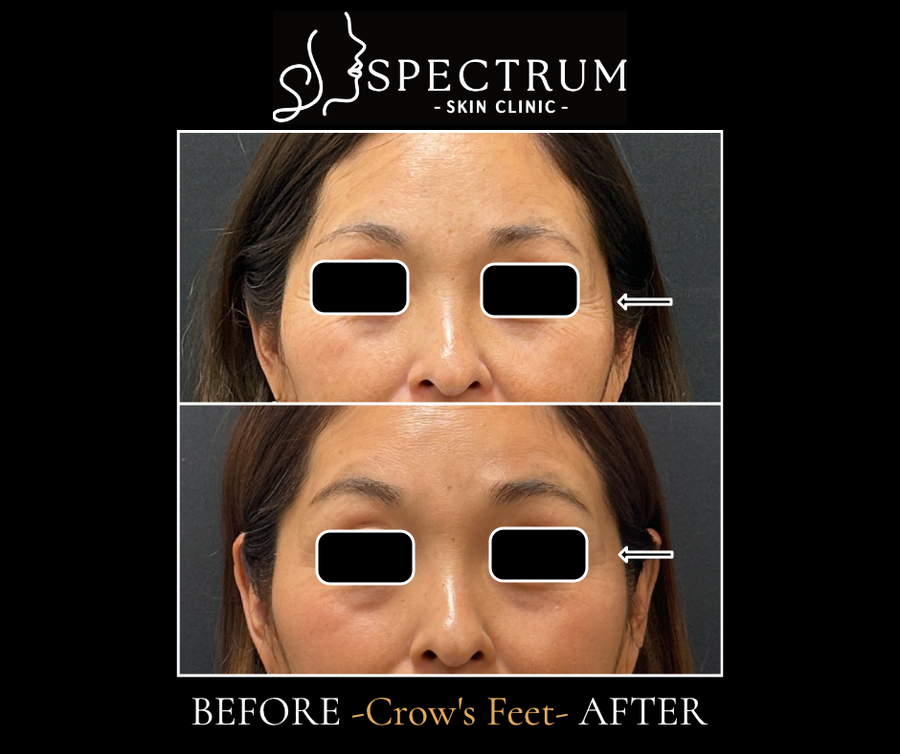
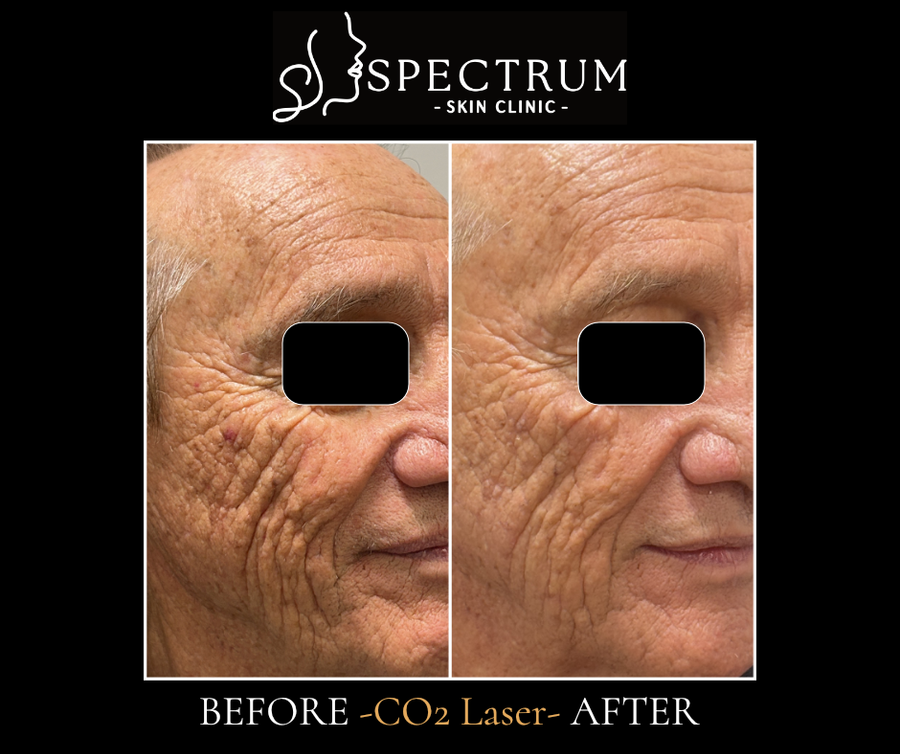
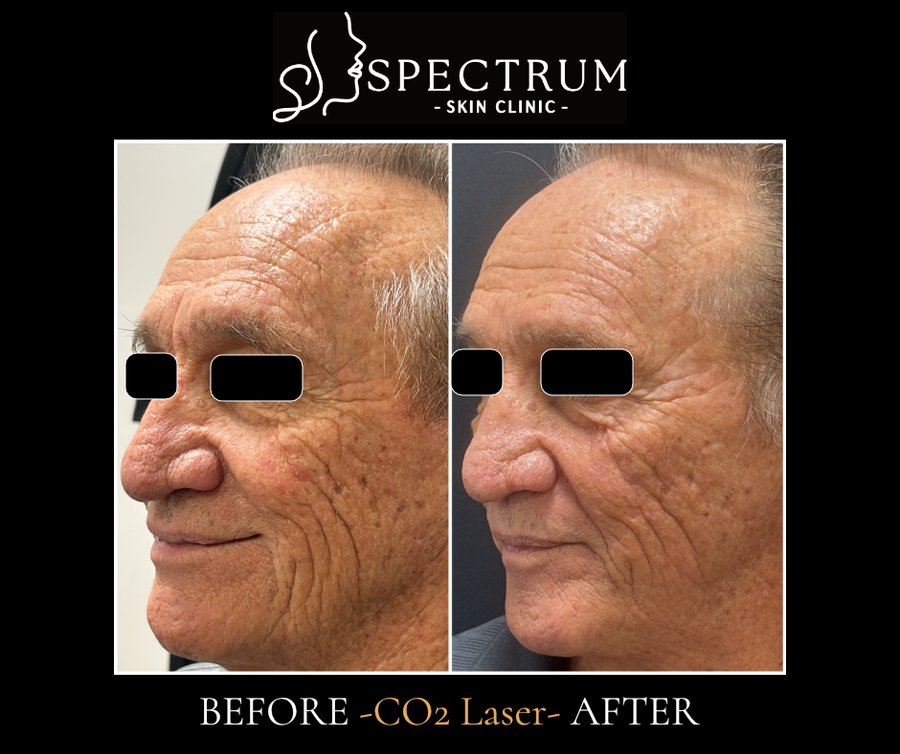
Fine Line and Wrinkle Results
Treated by Dr. Sabeen Munib, MD at Spectrum Skin Clinic in Irvine.
Why Lines Form, and Why That Changes the Treatment
Facial muscles fold the skin thousands of times a day. While collagen and elastin are intact, the skin springs back and the line disappears at rest. That is a dynamic line, and it responds to reducing the movement.
With time, ultraviolet exposure and falling collagen density, the same fold stops rebounding. The crease becomes visible at rest. At that point the problem has moved from the muscle into the skin, and softening the muscle alone will not remove it.
This is why the same treatment produces very different results in two patients of the same age. The question is not how old the skin is, but how much of the line is still movement and how much is now structure.
How the distinction is made
At rest and on animation, in good light, in person. A line that flattens when the skin is gently stretched is largely structural. A line that vanishes when the muscle relaxes is largely dynamic. Most faces show a mixture, and the proportion decides the plan.
Which kind of line do you have
Four Causes That Look Alike in the Mirror
This is the assessment, written out. It is also the fastest way to tell whether you are being sold the right treatment anywhere in Orange County.
Combined approaches
Why More Than One Tool Is Often Needed
Where a line has both a movement component and a structural component, treating only one leaves the patient half satisfied.
Candidacy
Who This Assessment Suits
Anyone who has been told a single treatment is the answer to their lines, or who has had a treatment that did not deliver what they expected, benefits from having the cause identified first.
How Dr. Munib decides
She looks at the face at rest and on animation, considers skin type, sun history and prior treatments, and identifies which cause is dominant. Where more than one is present she sequences them, usually addressing movement before resurfacing, because treating a line that is still being folded daily gives a shorter-lived result.
Likely a good fit
Patients with a mixture of movement and etched lines. Patients unsure whether they need a neuromodulator, resurfacing or something structural. Patients who have had a previous treatment that softened movement but left the line visible.
Where it is limited
Significant skin excess and jowling, where non-surgical treatment does not reach what the patient is picturing. Active infection or inflammation in the area. Pregnancy or breastfeeding for several of the options. Recent isotretinoin or unrealistic expectations about a single session.
What happens
What to Expect
Individual response varies with anatomy, skin type, sun history and adherence to aftercare. No outcome is guaranteed.
Risks
Documented Risks and Side Effects
Risk depends on which treatment is chosen. The relevant risks are reviewed with you for the specific plan rather than in general.
Bruising and swelling
Possible with any injectable. Usually settles within days.
Unintended muscle weakness
With neuromodulators, spread to a nearby muscle can cause temporary brow or lid droop. It resolves as the product wears off.
Pigment change after resurfacing
Post-inflammatory hyperpigmentation is a recognised risk, higher in deeper skin types and with sun exposure during healing.
Prolonged redness or delayed healing
More likely with deeper resurfacing settings and in patients with certain skin conditions or recent isotretinoin use.
Scarring
Uncommon with fractional devices but documented, particularly with infection or if aftercare is not followed.
Under-correction or asymmetry
Faces are not symmetrical and neither are results. Adjustment at review is part of the plan rather than a complication.
Risks, alternatives and expected outcome are reviewed with you before treatment and documented in your record.
How that risk is managed
Skin type and sun history are assessed before any resurfacing setting is chosen, and conservative settings are used where pigment risk is higher. Injectable and energy-based treatment is performed by Dr. Munib rather than delegated, and treatment is declined where the risk does not justify the likely benefit.
Aftercare and Recovery
Cost
What Affects Your Cost
Fine lines are quoted after assessment rather than from a flat menu price, because the cost depends on which cause is being treated. A neuromodulator is priced by units and by area. Resurfacing is priced by the area covered and the depth used. Collagen stimulation is priced per session in a series.
Where more than one cause is present, the plan is usually staged across visits rather than done at once, which spreads the cost as well as the downtime.
New patients: 15% off your first treatment.
Pay monthly with


Result philosophy
What a Good Result Looks Like
Softened rather than erased. A face that still moves and still reads as yours. Patients who ask for every line to be gone are usually describing a face that has stopped moving, which is a different and more obvious look.
Where a line cannot be fully removed without an unnatural result, Dr. Munib will say what is realistically achievable before treatment rather than after.
Explore
Related Treatments
Botox
For dynamic lines driven by muscle movement in the upper face.
Dysport Injections
An alternative neuromodulator, sometimes preferred for spread and onset.
Fractional CO2 Laser
Fractional resurfacing for lines etched into the skin at rest.
Fotona Erbium Laser Resurfacing
A lighter resurfacing option where downtime needs to be shorter.
Radio Frequency Micro-needling
RF microneedling for texture and collagen where laxity accompanies the lines.
Sculptra
Collagen stimulation over a series, for gradual structural change.
Rejuran PDRN | Orange County | Irvine, CA
Polynucleotide treatment aimed at skin quality rather than a single line.
Skin Tightening
Energy-based tightening where laxity rather than a discrete line is the concern.
Patient reviews
What Patients Say
4.97★ across 441 verified Boulevard patient reviews.
N. B.
J. Y.
D. T.
Questions
Frequently Asked Questions
Look at your face in a mirror at rest, without expression. Lines you can still see when nothing is moving are largely structural, and a neuromodulator alone will not remove them. Lines that appear only when you frown, squint or raise your brows are movement-driven and respond to a neuromodulator. Most faces have both, which is why the assessment matters more than the device.
The most common reason is that the treatment addressed a different cause from the one producing the line. A neuromodulator used on an etched line softens the movement around it but leaves the crease. Resurfacing used on a fold caused by volume loss does very little, because the shadow is structural rather than in the skin. Identifying which cause is dominant is the first step.
Usually not. The line from the nose to the corner of the mouth is generally a shadow cast by volume loss and midface descent rather than a crease in the skin. Treating it as a wrinkle is why some patients are disappointed. The support is often restored above the fold rather than in it, which is not where patients expect treatment to go.
Softened, usually. Erased, rarely, and attempting it often produces a face that has stopped moving and reads as treated. Dr. Munib will say what is realistically achievable for your lines before treatment rather than afterwards. Deeper etched lines generally improve rather than disappear.
It depends on the cause treated. Neuromodulator results typically last around three to four months because the effect wears off as movement returns. Resurfacing results last considerably longer but are undone by sun exposure. Collagen stimulation builds over months and is usually maintained with periodic sessions. Individual response varies.
It ranges from none to about a week depending on what is used. A neuromodulator has essentially no downtime. Light resurfacing usually means a few days of redness and flaking. Deeper resurfacing means longer. Where downtime is a constraint, that is factored into the plan and the treatment can often be staged.
No, and it is often better not to. Where more than one cause is present, treatment is usually sequenced across visits. Movement is commonly addressed before resurfacing, because resurfacing a line that is still being folded daily gives a shorter-lived result. Staging also spreads the cost and the downtime.
Dr. Sabeen Munib, MD performs all injectable, laser and energy-based treatment personally. The assessment that decides the plan is done by the same person who carries it out, which is not the case everywhere.
Irvine, CA