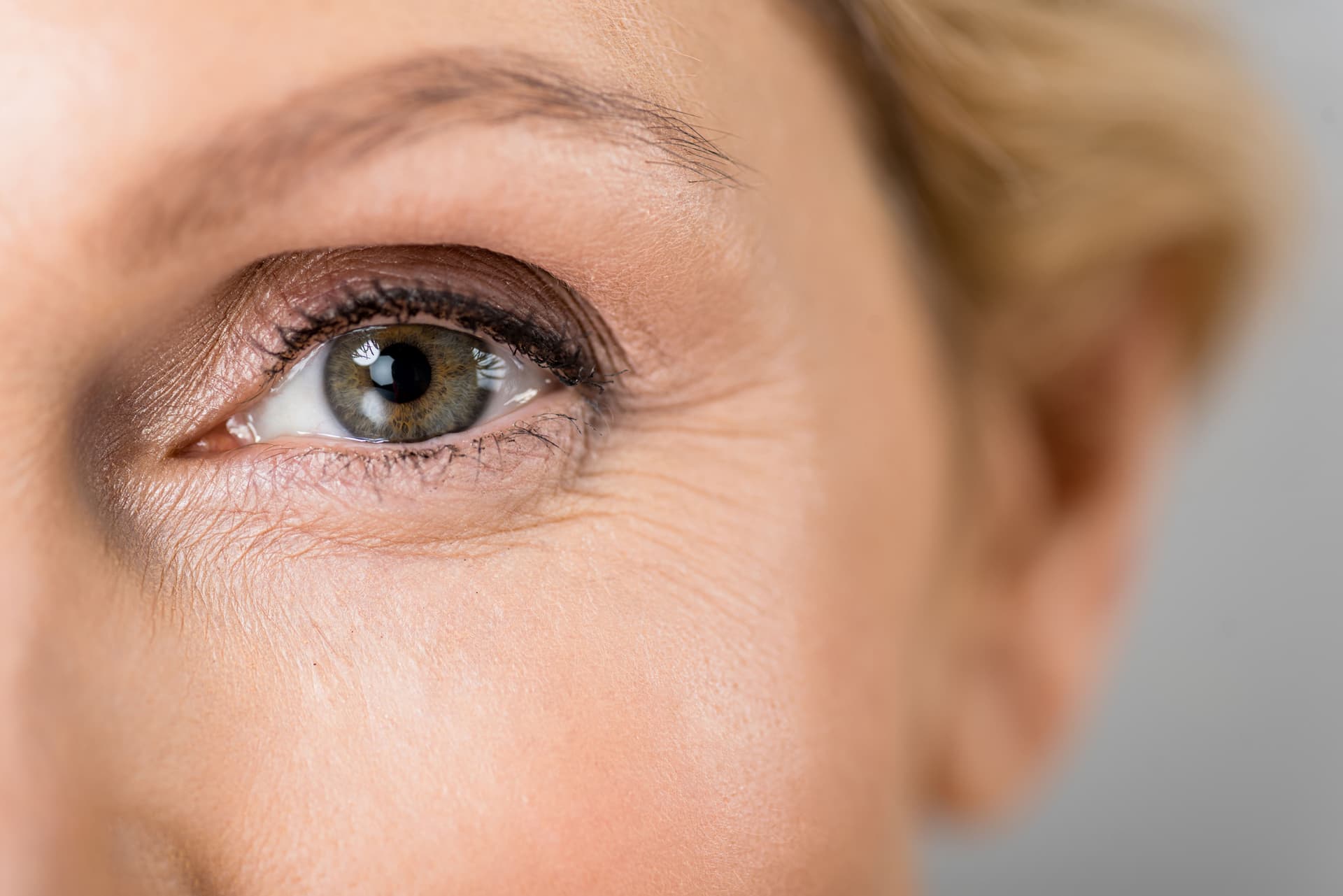
Crow's Feet Botox in Irvine, CA — Softer Lines Around the Eyes
Crow's feet Botox in Irvine, CA — relaxing the lateral eye muscle that creates smile lines. Sabeen Munib, MD.
Crow's Feet Botox in Irvine, CA: Softening Smile Lines
Crow's feet Botox in Irvine, CA relaxes the lateral part of the orbicularis oculi, the ring of muscle around the eye, that creases into fan-shaped lines at the outer corners when you smile or squint. Softening it smooths those lines while keeping the eyes expressive.
At Spectrum Skin Clinic in Irvine, Sabeen Munib, MD doses crow's feet to soften the lines without flattening a genuine smile, because over-treating this area can look unnatural.

Spectrum at a glance
| Starting price | Google rating | Patient reviews | Physician-performed | Experience |
|---|---|---|---|---|
| $15 / unit | 5.0★ Google | 441+ across platforms | 100% by Sabeen Munib, MD | 15+ years |
Spectrum Skin Clinic — Irvine
114 Pacifica, Suite 280, Irvine, CA 92618 · (949) 259-4790
Why patients choose Spectrum Skin Clinic for crow's feet Botox
Crow's feet Botox at Spectrum is performed personally by Sabeen Munib, MD, a physician with 15+ years in aesthetic medicine. The lateral orbicularis oculi sits a few millimetres from the zygomaticus major, the muscle that lifts the corner of the mouth into a genuine smile. Dosing here is judgment, not a recipe.
Dr. Munib starts conservative on the first treatment, places injections ≥1 cm lateral to the lateral canthus and superficial, reassesses at two weeks, and refers patients with significant static lines or lower-lid laxity to adjunct treatments rather than chasing the result with more units.
Medically reviewed by Sabeen Munib, MD.

Dynamic vs. Static Crow's Feet: Will Botox Help?
| What you see | What's happening | Where Botox fits |
|---|---|---|
| Lines fan out only on smile/squint; skin smooth at rest | Lateral orbicularis is contracting and folding thin skin | Well-suited; typically 8–12 units per side |
| Lines visible at rest, etched; deeper on smile | Repeated folding has creased the dermis itself | Botox softens the dynamic portion; static crease may need RF microneedling, resurfacing, or fine filler |
| Fine crepey under-eye texture, no smile-line pattern | Skin laxity and elastin loss, not muscle activity | Crow's feet Botox is not the right tool; periorbital RF, resurfacing, or PRFM may suit |
Crow's Feet Anatomy: Lateral Orbicularis Oculi
Crow's feet are produced by the lateral fibres of the orbicularis oculi, the sphincter-shaped muscle that closes the eye. On smiling and squinting these outer fibres fold the thin periorbital skin into fan-shaped lines radiating from the eye's corner. Crow's feet Botox targets these lateral fibres only.
What it deliberately AVOIDS: the medial orbicularis at the lower lid (lid closure, tear distribution), the zygomaticus major below (genuine smile), and the levator labii superioris medially (upper-lip elevation). Drift into any of these can produce a lazy lower lid, asymmetric smile, or lip ptosis. Sabeen Munib, MD places injections ≥1 cm lateral to the lateral canthus and superficial.
Bruising is slightly more common here than the forehead because periorbital skin is thin and crossed by fine vessels. Dr. Munib uses fine-gauge needles, slow injection, and asks patients to stop fish oil, vitamin E, NSAIDs, and alcohol 48 hours before treatment when not medically required.

How Many Units? The 3-Point Crow's Feet Pattern
| Point per side | Typical dose | Landmark |
|---|---|---|
| Point 1 (upper) | 2–4 units | ≥1 cm lateral to lateral canthus, in line with upper border of lateral brow |
| Point 2 (middle) | 2–4 units | ≥1 cm lateral to lateral canthus, in line with lateral canthus |
| Point 3 (lower) | 2–4 units | ≥1 cm lateral to lateral canthus, lower border of lateral brow — kept above zygomaticus |
Eye Bags, Eyelid Heaviness, and Why Placement Matters
The eye-bag appearance some patients describe after crow's feet Botox is uncommon and is usually not Botox spreading, it typically reflects lateral orbicularis relaxation allowing pre-existing lower-lid laxity or fat pads to read more prominently. True eyelid ptosis from a crow's feet injection is rare when units stay superficial and ≥1 cm lateral to the lateral canthus, because the levator palpebrae sits well medial and deep to that field. Sabeen Munib, MD mitigates these risks with low first-treatment units, lateral placement, and conservative depth. Reviewed by Sabeen Munib, MD on May 26, 2026.
When crow's feet Botox is the wrong procedure: significant lower-lid laxity, prominent pre-existing eye bags, or a thin lateral lid envelope. Dr. Munib will say so and suggest periorbital RF, fractional resurfacing, or under-eye filler / PRFM instead, not more Botox.
Why Crow's Feet Botox Is Usually Treated With the Forehead and Glabella
Crow's feet, forehead (frontalis), and glabella (corrugator + procerus) act as a balanced upper-face system. Relaxing one without considering the other two can shift expression, a frozen forehead next to active crow's feet, or a heavy brow if the lifters work without their depressors. Sabeen Munib, MD evaluates all three at consultation.
When the lateral orbicularis is relaxed, the brow tail may sit slightly higher, a subtle Botox brow lift. Combining crow's feet with a small dose of forehead or glabella Botox lets Dr. Munib shape upper-face position deliberately.
Dysport and Xeomin for Crow's Feet
Crow's feet Botox uses onabotulinumtoxinA; the same area can be treated with abobotulinumtoxinA (Dysport) or incobotulinumtoxinA (Xeomin). Dysport tends to spread slightly more, useful across a broader smile-line area, but it raises the bar for precise lateral placement near the eye. Xeomin lacks the accessory protein and may suit patients concerned about long-term antibody response.
Unit conversion is not 1:1 (Dysport runs roughly 2.5–3 units to 1 unit of Botox), so quoting 'units' across brands without naming the brand is misinformation. Sabeen Munib, MD selects based on prior response, smile-pattern width, and patient history.

Who May Be a Candidate
Crow's feet Botox may suit patients bothered by fan-shaped lines that appear when they smile or squint and want them softened without flattening the smile. Good candidates typically have dynamic lines that smooth out at rest. Less suited: etched static lines at rest, fine crepey under-eye texture, or significant pre-existing lower-lid laxity, these usually need an adjunct rather than more units.

What to Expect
An in-person consultation with Sabeen Munib, MD maps your smile pattern and decides whether crow's feet Botox alone, an upper-face combination, or an adjunct is the right plan. Injection takes about 5 minutes; the appointment is 20–30 minutes overall. Most patients return to normal activity the same day. Upright posture and avoidance of intense exercise, sauna, alcohol, and rubbing are advised for the rest of the day.

Safety Considerations
Side effects are typically mild and temporary: a small bruise (slightly more common around the eye), brief tenderness, occasionally a mild headache. Less common, dose- and technique-dependent: asymmetric smile if Botox drifts to the zygomaticus, heavy lower lid if a medial fibre is treated, eyelid ptosis (rare with lateral superficial placement). Pregnancy, breastfeeding, neuromuscular disorders, and active periorbital infection are contraindications.

Aftercare & Recovery
Stay upright for about 4 hours, avoid rubbing or massaging the area for 24 hours, and skip intense exercise, sauna, hot yoga, and alcohol the day of treatment. Makeup may be reapplied after about 4 hours. Most patients notice softening in 3 to 5 days, with the full effect at about 2 weeks.

What Affects Your Cost
Crow's feet Botox at Spectrum starts at $15 per unit. A typical treatment uses 16 to 24 units (8 to 12 per side). What changes the total: smile-line width, line depth, prior neuromodulator response, and whether crow's feet are treated alone or as part of an upper-face plan with the forehead and glabella. Unit price stays the same; unit count is set at consultation.

Will Crow's Feet Botox Change My Smile?
Not when it is dosed carefully. The lateral orbicularis contributes to the eye-crinkle of a genuine smile, so under-dosing and lateral placement preserve the smile while smoothing surface lines. Over-treating this area produces a flat smile, Sabeen Munib, MD treats conservatively at first and reassesses at two weeks.
Crow's Feet Botox Results Timeline
| Time after treatment | What to expect |
|---|---|
| Day 0 | Tiny injection bumps for 15–30 minutes; possible mild redness; rare small bruise |
| Days 3–5 | Lines start softening as the muscle relaxes |
| Day 14 | Full effect — smoothest crow's feet appearance |
| Months 2–3 | Movement gradually returns |
| Months 3–4 | Consider re-treatment to maintain |
Related Treatments
Crow's feet Botox is part of a broader upper-face plan. Related options at Spectrum: Botox pillar overview, forehead Botox, glabella Botox (11 frown lines), Botox brow lift, bunny lines Botox, DAO Botox, masseter Botox (TMJ / jaw slimming), Nefertiti lift, Dysport vs Botox, and CO2 laser resurfacing for static eye-area lines.
Botox softens the muscle movement that creases the skin. For the etched lines that remain at rest, see Erbium Laser Resurfacing. The two address different components, and Dr. Munib will say which is doing the work in your case.
Reference
Dosing and safety here align with peer-reviewed literature on lateral periorbital neuromodulator placement (Carruthers et al., PMC10374187).
Book a Crow's Feet Botox Consultation in Irvine
Crow's feet Botox at Spectrum Skin Clinic in Irvine is performed personally by Sabeen Munib, MD. Consultations are in-person; dosing is set after your smile pattern is assessed.
Patient Reviews
4.97★ · 441 Patient Reviews

I had an amazing experience with Dr. Munib, who performed my aesthetic treatments including Pico laser, Botox, a glassy facial, Botox for migraine, and HIFU. Every procedure was done with great care, precision, and professionalism, and the results exceeded my expectations. Dr. Munib is incredibly knowledgeable and takes the time to explain everything, making me feel comfortable and confident throughout the process. Her expertise truly shows in her work. The staff was extremely accommodating, friendly, and professional, which made the entire experience even better. On top of that, the prices were very reasonable for the quality of service provided. I highly recommend Dr. Munib to anyone looking for outstanding aesthetic treatments and excellent patient
Mahjabeen Saeed
4 months ago

I had an excellent experience with Dr. Sabeen Munib at Spectrum Skin Clinic in Irvine. I visited her for acne scar treatment and underwent three subcision sessions spaced six weeks apart. Throughout my treatment, I was consistently impressed by her expertise, attention to detail, and compassionate approach. Dr. Munib took the time to carefully evaluate my scars, explain the procedure, and answer all of my questions before starting. During each procedure, she made sure I was comfortable and informed every step of the way. Her technique, skill and experience with acne scar subcision gave me complete confidence that I was in capable hands. The entire team at Spectrum Skin Clinic was professional, friendly, and supportive throughout the process. Although acne scar improvement takes time and healing, I appreciate that Dr. Munib focuses on achieving the best possible long-term results rather than making unrealistic promises. She explained what to expect during recovery and emphasized that collagen remodeling happens gradually. If you're looking for a knowledgeable and caring physician for acne scar treatment or subcision, I highly recommend Dr. Sabeen Munib Spectrum Skin Clinic, Irvine. I truly appreciate the care, professionalism, and dedication I received and would not hesitate to recommend her to anyone seeking advanced scar treatment.
Deepak Jadhav
3 months ago

After several aesthetic nurses told me I was allergic to filler dissolver, Dr. Munib took a careful, evidence-based approach. She used ultrasound to locate my migrated lip filler, tested a small area first, and explained I was reactive—not allergic. She dissolved a small test area before safely treating my upper lip. Throughout the process she was gentle, thorough, and educational. It’s a long drive for me, but her knowledge and expertise make it absolutely worth it.
Jamel Neill
2 months ago

Thank GOD for Dr. Munib. She is the angel of dissolver!!! I had HA nodules and Sculptra nodules from previously going to Dermfx and I went to Dr. Munib for ultrasound guided dissolving. She is gentle, patient, knowledgeable, kind and funny. I feel like she is the last of the good ones in this business. If you are interested in natural looking aesthetic results that aren’t botched and don’t cause you years of facial pain go to her. I would try to see her as my primary doc if I wasn’t moving out of the area. I would travel to go see her though.
Siena Viencek-Walsh
3 months ago
Real Patient Results
All treatments performed personally by Sabeen Munib, MD at Spectrum Skin Clinic, Irvine.
Related Blogs
Personalized Aesthetic & Regenerative Solutions Designed to Heal, Enhance & Restore Naturally
Frequently Asked Questions
Got questions? We’re here to help! Find out what we offer, how to book an appointment, where we’re located, and more. We treat all age groups and offer skincare products too.