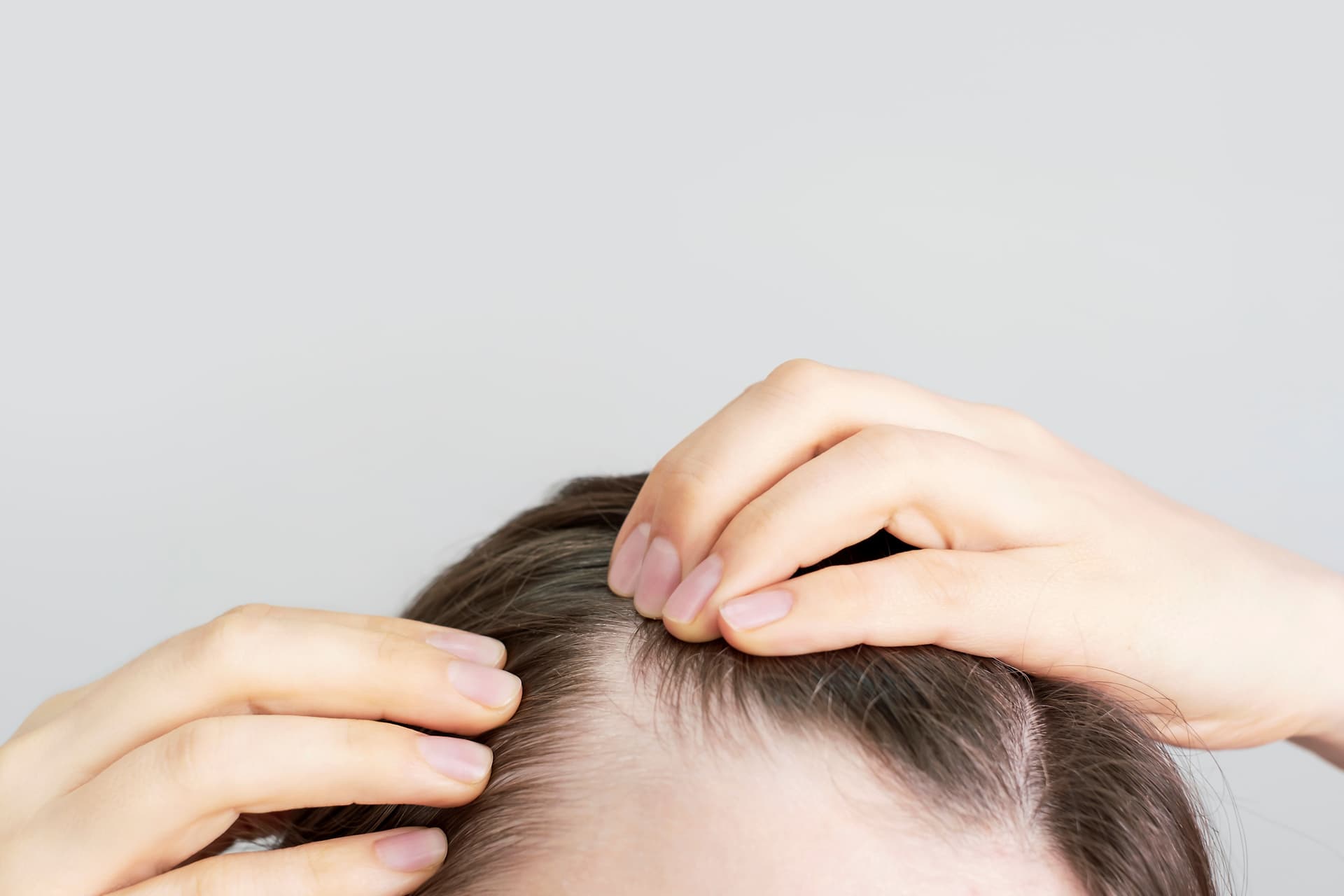
Hair Loss Treatment in Irvine, CA
Physician-led, non-surgical hair restoration in Irvine — PRFM, PRP, and exosome therapy for thinning hair.
Non-Surgical Hair Restoration in Irvine, CA
Hair restoration at Spectrum Skin Clinic begins with a diagnosis, not a product. Sabeen Munib, MD reviews the pattern of thinning, the medical history, and the health of the follicles before any plan is set.
The clinic's hair restoration is non-surgical and led by exosome therapy, supported by PRFM and PRP. These advanced hair restoration methods aim to support active follicles and slow visible loss.
Where the right answer is a surgical hair transplant, this page explains how the options compare and when a referral makes sense.

Spectrum at a glance
| Starting price | Google rating | Patient reviews | Physician-performed | Experience |
|---|---|---|---|---|
| Quoted at consultation | 5.0★ Google | 441+ across platforms | 100% by Sabeen Munib, MD | 15+ years |
Spectrum Skin Clinic — Irvine
114 Pacifica, Suite 280, Irvine, CA 92618 · (949) 259-4790
Why Patients Choose Spectrum for Hair Restoration
Sabeen Munib, MD is the hair restoration doctor who leads every case here. As a hair restoration specialist, she classifies the loss before treating, since the thinning may reflect pattern baldness, a medical driver, or another form of alopecia.
The clinic is honest about what non-surgical care can and cannot do. Non-surgical hair restoration may slow loss and support density, but it cannot replace follicles that are already gone.
Care stays with one physician from the initial consultation through follow-up. That continuity lets the plan adjust as the hair responds over the months that hair growth takes.
Medically reviewed by Sabeen Munib, MD.

How Non-Surgical Hair Restoration Works
Spectrum's advanced hair restoration delivers growth signals to follicles that are still alive but weakening. Exosome therapy adds laboratory-prepared signals, often paired with microneedling so the scalp absorbs them.
PRFM and PRP concentrate the patient's own platelets, which release factors that support the follicle. The aim is to extend the active growth phase and encourage new hair to grow from follicles that have been thinning.
None of these steps involves a scalpel, an incision, or a graft. Treatment is minimally invasive, uses only topical or local comfort measures, and needs no surgical recovery.

Why Diagnosis Comes First
Hair loss and hair thinning have many causes, and the treatment that helps one pattern wastes time on another. The consultation reviews the treatment options after classifying the type of loss.
This matters because non-surgical hair restoration depends on living follicles. When the follicles in an area are no longer viable, the honest path may be a surgical hair transplant rather than another round of injections.
Where Treatment Is Focused on the Scalp
Treatment is concentrated where the thinning shows: a receding hairline, a widening part, or a thinning crown. The goal is to raise hair density in the zones that remain active.
Areas where the follicles are fully dormant are noted but not over-treated. Honest mapping of the scalp keeps expectations realistic and the plan focused on existing hair.
Matching the Treatment to the Hair Loss
| Concern | Often pairs with | Why |
|---|---|---|
| Diffuse thinning across the scalp | Exosome therapy with microneedling | Spreads growth signals where density is dropping |
| Early thinning, active follicles | PRFM or PRP | Supports follicles before the loss advances |
| A medical or hormonal driver | Rx hair therapy | Treats the cause, not only the surface |
Non-Surgical Hair Restoration vs. Hair Transplant (FUE and FUT)
| Approach | What it involves | When it is considered |
|---|---|---|
| Non-surgical (exosomes, PRFM, PRP) | In-office injections or microneedling, no incision and no general anesthesia | Early to moderate thinning where follicles remain active |
| FUE hair transplant | Follicular unit extraction, also called follicular unit excision: individual hair follicles are taken from the donor area one graft at a time under local anesthesia, then implanted into the thinning area | An established hair loss pattern with a healthy donor site |
| FUT hair transplant | Follicular unit transplantation, or strip surgery: a strip of donor scalp is removed and divided into individual hair grafts | Larger sessions needing many grafts in a single outpatient procedure |

Who May Be a Good Candidate
Good candidates for non-surgical hair restoration have early to moderate thinning and follicles that still produce hair. Acting before the loss is advanced gives the follicles more to work with.
Overall health and medical history matter, since some hair loss is driven by treatable medical conditions. Patients with advanced pattern baldness may be better served by a hair transplant, which the consultation will make clear.

What to Expect and Timeline
Non-surgical hair restoration is a series, not a single visit. Most plans involve several sessions spaced weeks apart, because follicles respond gradually rather than overnight.
New hair growth tends to appear over a span of months as the follicles cycle. Shedding may briefly increase early on, which is expected, and density is judged over the longer arc.

Safety and Who May Not Be a Candidate
Because PRFM and PRP use the patient's own blood, the main considerations are careful handling and a review of the medical history. Exosome therapy is screened the same way.
Non-surgical hair restoration may not fit when the follicles in an area are no longer active, when loss advances quickly, or when a medical contraindication exists. In those cases Dr. Munib says so directly.

Aftercare and Recovery
- Leave the scalp undisturbed for the first day, avoiding harsh products and vigorous washing.
- Skip heavy exercise, saunas, and direct heat for the first day or two.
- Avoid blood thinners around treatment only when Dr. Munib has advised it.
- Expect mild redness or tenderness that settles quickly, with no surgical downtime.
- Keep follow-up visits so the plan can adjust as the hair responds.

What Affects Your Cost
Cost depends on which hair restoration treatments the plan calls for, how many sessions are needed, and whether therapies are combined. A hub of options like this has no single price.
Dr. Munib gives transparent pricing at the consultation once the plan is set, so the cost reflects the actual treatment plan rather than a generic package.

Will Non-Surgical Hair Restoration Regrow Hair?
It may regrow hair from follicles that are still active, improve hair density, and slow further thinning. It cannot regrow a full head of hair where the follicles are already lost.
Non-surgical hair loss therapy works as an early intervention on existing hair. When the goal is to rebuild a region with no living follicles, a hair transplant is the honest answer.
Related Hair Restoration Treatments
For laboratory-prepared growth signals delivered with microneedling, see Exosome Hair Treatment, the clinic's lead approach.
For platelet-based hair restoration using the patient's own growth factors, see PRFM Hair Restoration.
For a medically driven plan that treats the cause of the loss, see Rx Hair Restoration.
For hair loss in women and the female pattern, see Female Pattern Hair Loss.
For men's hair loss and male pattern baldness, see Male Pattern Baldness.
For drug- and hormone-free growth factor stimulation, see AnteAGE Growth Factors.
Book Hair Restoration in Irvine, CA
Schedule a consultation with Sabeen Munib, MD to map the loss and build a plan. Serving Irvine and Orange County, the clinic will say honestly whether non-surgical hair restoration or a hair transplant fits the patient's goals.
Patient Reviews
4.97★ · 441 Patient Reviews

I had an amazing experience with Dr. Munib, who performed my aesthetic treatments including Pico laser, Botox, a glassy facial, Botox for migraine, and HIFU. Every procedure was done with great care, precision, and professionalism, and the results exceeded my expectations. Dr. Munib is incredibly knowledgeable and takes the time to explain everything, making me feel comfortable and confident throughout the process. Her expertise truly shows in her work. The staff was extremely accommodating, friendly, and professional, which made the entire experience even better. On top of that, the prices were very reasonable for the quality of service provided. I highly recommend Dr. Munib to anyone looking for outstanding aesthetic treatments and excellent patient
Mahjabeen Saeed
4 months ago

I had an excellent experience with Dr. Sabeen Munib at Spectrum Skin Clinic in Irvine. I visited her for acne scar treatment and underwent three subcision sessions spaced six weeks apart. Throughout my treatment, I was consistently impressed by her expertise, attention to detail, and compassionate approach. Dr. Munib took the time to carefully evaluate my scars, explain the procedure, and answer all of my questions before starting. During each procedure, she made sure I was comfortable and informed every step of the way. Her technique, skill and experience with acne scar subcision gave me complete confidence that I was in capable hands. The entire team at Spectrum Skin Clinic was professional, friendly, and supportive throughout the process. Although acne scar improvement takes time and healing, I appreciate that Dr. Munib focuses on achieving the best possible long-term results rather than making unrealistic promises. She explained what to expect during recovery and emphasized that collagen remodeling happens gradually. If you're looking for a knowledgeable and caring physician for acne scar treatment or subcision, I highly recommend Dr. Sabeen Munib Spectrum Skin Clinic, Irvine. I truly appreciate the care, professionalism, and dedication I received and would not hesitate to recommend her to anyone seeking advanced scar treatment.
Deepak Jadhav
3 months ago

After several aesthetic nurses told me I was allergic to filler dissolver, Dr. Munib took a careful, evidence-based approach. She used ultrasound to locate my migrated lip filler, tested a small area first, and explained I was reactive—not allergic. She dissolved a small test area before safely treating my upper lip. Throughout the process she was gentle, thorough, and educational. It’s a long drive for me, but her knowledge and expertise make it absolutely worth it.
Jamel Neill
2 months ago

Thank GOD for Dr. Munib. She is the angel of dissolver!!! I had HA nodules and Sculptra nodules from previously going to Dermfx and I went to Dr. Munib for ultrasound guided dissolving. She is gentle, patient, knowledgeable, kind and funny. I feel like she is the last of the good ones in this business. If you are interested in natural looking aesthetic results that aren’t botched and don’t cause you years of facial pain go to her. I would try to see her as my primary doc if I wasn’t moving out of the area. I would travel to go see her though.
Siena Viencek-Walsh
3 months ago

Frequently Asked Questions
Got questions? We’re here to help! Find out what we offer, how to book an appointment, where we’re located, and more. We treat all age groups and offer skincare products too.