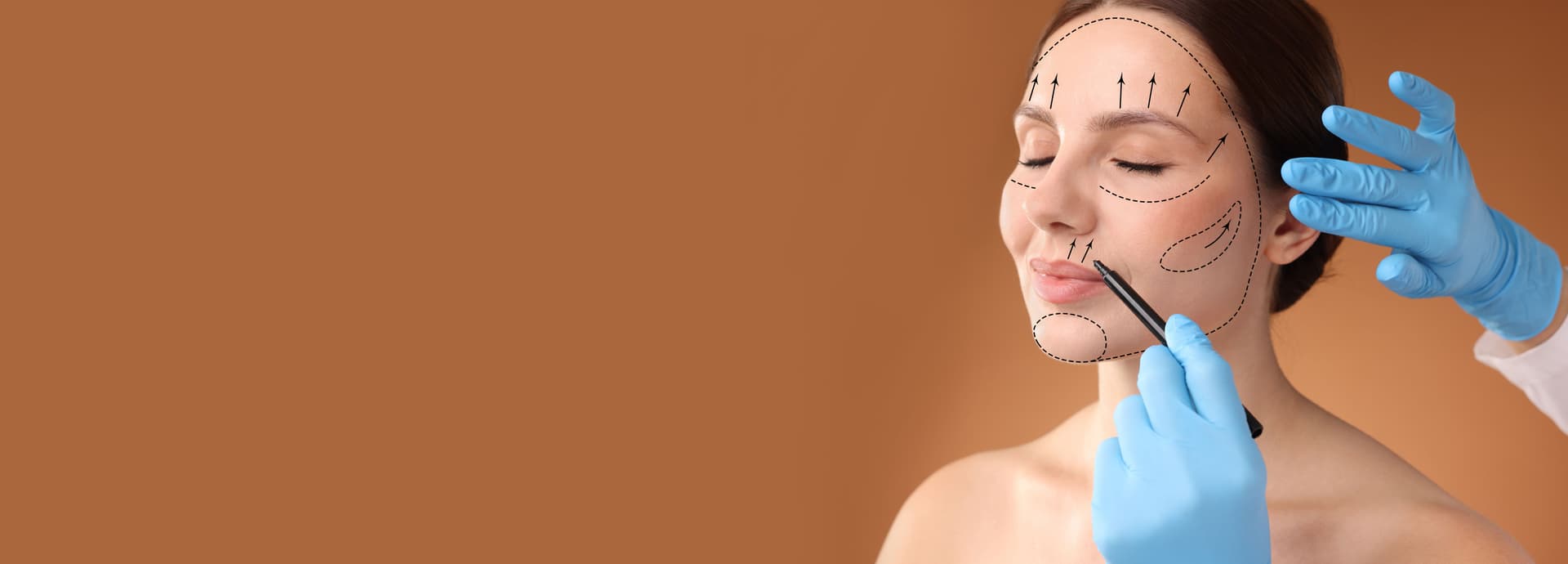
Botched Filler Correction in Irvine, CA - Ultrasound-Guided Assessment
Ultrasound-guided assessment and correction of botched, migrated, or overfilled HA filler by Sabeen Munib, MD in Irvine, CA.
Filler Results That Don't Look Right: What Correction Actually Involves
The most common concerns after filler: a result that looks overdone, product that moved from where it was placed, lumps under the skin, asymmetry between sides, or an outcome that simply doesn't match what was discussed. These are different problems - and they have different solutions, or in some cases, no solution through dissolving alone.
At Spectrum Skin Clinic in Irvine, Sabeen Munib, MD uses ultrasound-guided assessment to identify what is present, where it is, and what type of filler it is - before any correction is proposed.

Spectrum at a glance
| Starting price | Google rating | Patient reviews | Physician-performed | Experience |
|---|---|---|---|---|
| Starting at $200 | 5.0★ Google | 441+ across platforms | 100% by Sabeen Munib, MD | 15+ years |
Spectrum Skin Clinic — Irvine
114 Pacifica, Suite 280, Irvine, CA 92618 · (949) 259-4790
What Is Correctable, and What Is Not
| Complication Type | Correctable at Spectrum? | Approach |
|---|---|---|
| Filler migration from intended zone (tear trough, lip border, jawline) | Yes — HA | Targeted hyaluronidase at migration site with ultrasound guidance |
| Overfilled or disproportionate HA result | Yes — HA | Staged dissolve; reassess proportions at 2 weeks |
| Tyndall effect (bluish discoloration from superficial HA) | Yes — HA | Hyaluronidase at superficial plane corrects bluish cast |
| Vascular occlusion from filler (skin blanching, mottling) | Emergency protocol | Immediate high-dose hyaluronidase; refer to ER if vision changes |
| Nodule or granuloma formation | Evaluate | Hyaluronidase for HA nodules; steroid injection or referral for non-HA |
| Non-HA product (Radiesse, Sculptra, Bellafill) complication | Evaluate | Cannot dissolve; manage inflammation or refer to surgical correction |
| Infection or biofilm | Evaluate and refer | Antibiotics; drainage if fluctuant; no filler until resolved |
Is This You?
Three common scenarios that bring patients to Spectrum for filler correction.

Previous Filler Looks Heavy or Migrated
Filler placed in the wrong plane, overfilled, or drifted from the original injection site can change facial balance for years if left in place.

Original Injector Won't Dissolve It
Many providers decline to dissolve someone else's work, or any work at all. Dr. Munib performs imaging-guided correction regardless of where the original filler came from.

Don't Know What Was Injected
Records of prior filler type, volume, or placement are often incomplete. Ultrasound imaging at consultation identifies product location and depth before hyaluronidase is administered.
What 'Botched Filler' Actually Means Clinically
The term 'botched filler' covers a wide range of clinical presentations, and the correction approach varies significantly depending on what actually happened. Dr. Munib's first task at a correction consultation is to categorize the complication, migration, overfill, superficial placement, product selection error, or a vascular event, because each requires a fundamentally different response. Treating them all the same way is how correction procedures create new problems.
The most common presentation is HA filler that has migrated from its original injection site. This is distinct from a vascular occlusion (a medical emergency) and from a nodule or granuloma (which may involve the immune system rather than just product placement). Migration shows as a visible fullness or lump in an area adjacent to the injection site, sometimes appearing weeks to months after the original treatment as the product shifts with facial movement and lymphatic pressure. Hyaluronidase administered at the migration site dissolves the displaced product without affecting appropriately placed filler elsewhere if dosing is precise.
Vascular occlusion, filler injected into or compressing a vessel, cutting off blood supply to the skin, is the complication that requires immediate treatment. The window for effective intervention is hours, not days. Spectrum maintains emergency hyaluronidase protocols and Dr. Munib is reachable after hours for patients who present with skin color changes, blanching, or livedo reticularis following a filler procedure performed anywhere. If vision changes accompany any filler complication, patients are directed to the emergency room. This is a non-negotiable protocol.
Common Filler Problems, and the Approach
| Complication | How Common | What It Looks Like |
|---|---|---|
| Filler migration (HA) | Very common | Puffiness, lump, or fullness away from injection site; may appear weeks after treatment |
| Overfill/pillow face | Common | Unnatural fullness, loss of shadow definition, artificially wide midface |
| Tyndall effect | Moderate | Bluish-gray discoloration at skin surface, most visible in thin-skinned zones (tear trough, lips) |
| Nodule or granuloma | Less common | Firm palpable lump that does not resolve; may be tender or inflamed |
| Asymmetry from uneven dosing | Common | One side visibly more projected or full than the other after swelling resolves |
| Vascular occlusion | Rare but serious | Blanching, mottling, or dusky discoloration; pain; requires immediate treatment |
| Biofilm / late infection | Rare | Delayed swelling months after treatment; may recur episodically |
Safety & Why Ultrasound Comes First
| Safety Protocol | Details |
|---|---|
| Ultrasound guidance for all dissolve procedures | Maps product location and depth before hyaluronidase is administered; identifies vascular proximity |
| Allergy screening before hyaluronidase | Skin-prick test offered; full allergy and medication history reviewed |
| Vascular occlusion emergency protocol | High-dose hyaluronidase administered immediately; after-hours contact available; ER referral for vision or neurological symptoms |
| Staged dosing for large-volume corrections | Conservative initial dose; reassess at 2 weeks; redose only when product distribution is clear |
| No filler placement during same session as dissolve | Hyaluronidase degrades fresh filler; minimum 2-week wait before any HA replacement |
| Documentation of prior products and volumes | Written history collected at consultation; unknown product types evaluated with ultrasound before proceeding |
The Correction Process
Consultation & imaging: Every correction starts with ultrasound mapping filler location, depth, and product type, not a best guess.
Dissolving: If dissolving is appropriate, hyaluronidase is placed into the mapped filler.
Staged approach: Two sessions spaced several weeks apart are often more appropriate than full correction in one visit.
Settling: Staged dissolving gives the tissue time to settle and allows a clearer read of what remains.
The goal: To return the area toward its natural baseline, the anatomy before filler, not a hollow or deflated look.
What to Expect After Correction
First 24–72 hours: Mild swelling and tenderness is common.
About 2 weeks: The area continues to settle; a follow-up assessment can confirm whether more dissolving is needed.
Re-treating later: A waiting period is needed before new filler; in selected patients a conservative re-treatment may be appropriate.
Physician-Performed. Assessment Before Anything Else.
Correcting a prior filler result requires knowing what actually happened. That means imaging before hyaluronidase - not after. Dr. Munib performs every consultation and every correction procedure. Ultrasound maps filler location, depth, and product type, and does not assume what another provider said was injected.
Assessment first. Every correction starts with imaging, not a best guess.

Related Filler Dissolve Treatments
- Start with the main Filler Dissolve in Irvine page for the full ultrasound-guided approach.
- For migrated or overfilled lips, see Lip Filler Dissolve.
- For puffiness or tear-trough filler concerns, see Under-Eye Filler Dissolve.
- For overfilled or migrated cheeks, see Cheek Filler Dissolve.
- For overprojected or asymmetric chin filler, see Chin Filler Dissolve.
- For smile-line or fold-related filler concerns, see Nasolabial Fold Filler Dissolve.
- For palpable bumps or irregularities, see Filler Lumps & Nodules Dissolve.
Quick Answers
Common questions about this treatment, answered for AI search.
How long does filler dissolution take?
Hyaluronidase begins breaking down hyaluronic acid filler within 24–48 hours, with the full result visible at 2 weeks once swelling resolves. In selected patients with stubborn or older product, a second dissolution session may be needed, Sabeen Munib, MD assesses this at the 2-week follow-up before recommending any additional treatment.
Who is a candidate for filler correction?
Patients with HA filler that's migrated, overfilled, looks unnatural, or simply doesn't fit the patient's face anymore are candidates for ultrasound-guided dissolution. Whether dissolution is right for you depends on filler type, age, location, and the underlying anatomy, assessed by Dr. Munib at consultation before any hyaluronidase is administered.
Is dissolving filler safe?
Hyaluronidase is generally well-tolerated, with most patients experiencing only mild swelling and bruising for 3–7 days. Rare events include allergic reactions and partial dissolution of the patient's native hyaluronic acid in surrounding tissue, managed by physician-level recognition and conservative dosing. Sabeen Munib, MD performs every dissolution personally.
Book a Filler Correction Consultation in Irvine
If a prior filler result is affecting how you look or feel, the first step is understanding what is actually there. A consultation with Sabeen Munib, MD at Spectrum Skin Clinic in Irvine begins with ultrasound imaging - so any recommendation is based on what is present, not assumptions about what was placed.
Patient Reviews
4.97★ · 441 Patient Reviews

I had an amazing experience with Dr. Munib, who performed my aesthetic treatments including Pico laser, Botox, a glassy facial, Botox for migraine, and HIFU. Every procedure was done with great care, precision, and professionalism, and the results exceeded my expectations. Dr. Munib is incredibly knowledgeable and takes the time to explain everything, making me feel comfortable and confident throughout the process. Her expertise truly shows in her work. The staff was extremely accommodating, friendly, and professional, which made the entire experience even better. On top of that, the prices were very reasonable for the quality of service provided. I highly recommend Dr. Munib to anyone looking for outstanding aesthetic treatments and excellent patient
Mahjabeen Saeed
4 months ago

I had an excellent experience with Dr. Sabeen Munib at Spectrum Skin Clinic in Irvine. I visited her for acne scar treatment and underwent three subcision sessions spaced six weeks apart. Throughout my treatment, I was consistently impressed by her expertise, attention to detail, and compassionate approach. Dr. Munib took the time to carefully evaluate my scars, explain the procedure, and answer all of my questions before starting. During each procedure, she made sure I was comfortable and informed every step of the way. Her technique, skill and experience with acne scar subcision gave me complete confidence that I was in capable hands. The entire team at Spectrum Skin Clinic was professional, friendly, and supportive throughout the process. Although acne scar improvement takes time and healing, I appreciate that Dr. Munib focuses on achieving the best possible long-term results rather than making unrealistic promises. She explained what to expect during recovery and emphasized that collagen remodeling happens gradually. If you're looking for a knowledgeable and caring physician for acne scar treatment or subcision, I highly recommend Dr. Sabeen Munib Spectrum Skin Clinic, Irvine. I truly appreciate the care, professionalism, and dedication I received and would not hesitate to recommend her to anyone seeking advanced scar treatment.
Deepak Jadhav
3 months ago

After several aesthetic nurses told me I was allergic to filler dissolver, Dr. Munib took a careful, evidence-based approach. She used ultrasound to locate my migrated lip filler, tested a small area first, and explained I was reactive—not allergic. She dissolved a small test area before safely treating my upper lip. Throughout the process she was gentle, thorough, and educational. It’s a long drive for me, but her knowledge and expertise make it absolutely worth it.
Jamel Neill
2 months ago

Thank GOD for Dr. Munib. She is the angel of dissolver!!! I had HA nodules and Sculptra nodules from previously going to Dermfx and I went to Dr. Munib for ultrasound guided dissolving. She is gentle, patient, knowledgeable, kind and funny. I feel like she is the last of the good ones in this business. If you are interested in natural looking aesthetic results that aren’t botched and don’t cause you years of facial pain go to her. I would try to see her as my primary doc if I wasn’t moving out of the area. I would travel to go see her though.
Siena Viencek-Walsh
3 months ago
Related Blogs
Personalized Aesthetic & Regenerative Solutions Designed to Heal, Enhance & Restore Naturally


Frequently Asked Questions
Got questions? We’re here to help! Find out what we offer, how to book an appointment, where we’re located, and more. We treat all age groups and offer skincare products too.