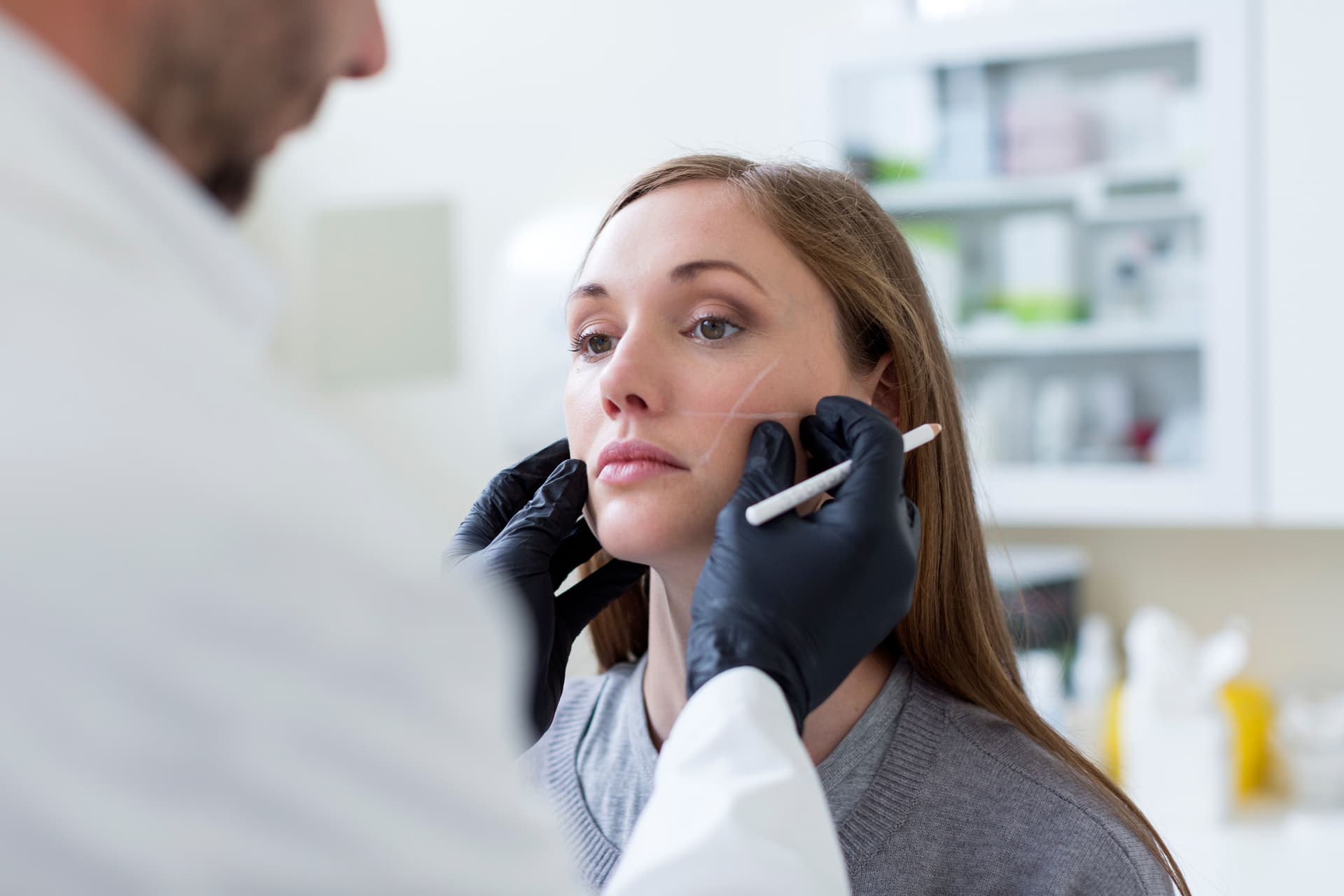
Cheek Filler Dissolve in Irvine, CA — Ultrasound-Guided Correction
Ultrasound-guided dissolving of overfilled, heavy, or migrated cheek filler with Sabeen Munib, MD in Irvine, CA.
Cheek Filler Dissolve in Irvine, CA: Correcting Overfilled, Heavy, or Migrated Cheeks
Overfilled cheeks are one of the most common reasons patients ask about dissolving filler. Too much product in the midface, or filler that has migrated toward the under-eye or smile lines, can read as heaviness, a shelf when you smile, or a widened, rounded look that no longer fits your face.
At Spectrum Skin Clinic in Irvine, Sabeen Munib, MD uses ultrasound-guided hyaluronidase to map and dissolve cheek filler precisely. Imaging shows where the product sits and how deep it is, so the problematic filler can be addressed while surrounding tissue is left alone.

Spectrum at a glance
| Starting price | Google rating | Patient reviews | Physician-performed | Experience |
|---|---|---|---|---|
| Starting at $200 | 5.0★ Google | 441+ across platforms | 100% by Sabeen Munib, MD | 15+ years |
Spectrum Skin Clinic — Irvine
114 Pacifica, Suite 280, Irvine, CA 92618 · (949) 259-4790
What Can Be Dissolved, and What Can't
| Product Type | Dissolvable? | Notes |
|---|---|---|
| Hyaluronic acid fillers (Juvederm Voluma, Restylane Lyft, Versa) | Yes | Primary indication for hyaluronidase |
| Calcium hydroxylapatite (Radiesse) | No | Not dissolvable; requires waiting for natural metabolism |
| Poly-L-lactic acid (Sculptra) | No | Stimulates collagen; not dissolvable |
| PMMA (Bellafill) | No | Permanent; surgical correction if removal required |
| Unknown product | Evaluate first | Ultrasound used to confirm filler type before proceeding |
Is This You?
Three common reasons patients come to Spectrum for cheek filler correction.

Cheek Filler Looks Puffy in Photographs
Overfilled or migrated cheek product can create a 'pillowy' midface that reads heavier on camera than it does in the mirror. Ultrasound identifies what's there and where.
Asymmetry Between the Two Sides
Uneven projection, asymmetric volume, or one cheek that's drifted while the other held position is a common reason patients seek correction rather than more filler.

Want to Start Over Before Adding More
Stacking new product on existing filler that's in the wrong plane rarely fixes the underlying issue. Targeted dissolution first preserves your own tissue and lets the next plan start clean.
Why Cheek Filler Is Tricky to Dissolve
Cheek filler dissolve is one of the higher-stakes hyaluronidase procedures performed at Spectrum Skin Clinic because the cheek occupies the structural apex of the midface. Volume placed in this zone supports the tear trough, softens the nasolabial fold, and contributes to overall facial projection. When dissolve is performed without accounting for these downstream effects, patients can be left with hollowing, accentuated under-eye shadows, or a deflated appearance that was not part of the presenting complaint.
The anatomy of the cheek also presents vascular risk. The facial artery, its angular branch, and the infraorbital vessels all traverse the midface region where filler is commonly placed. Injecting hyaluronidase near these structures requires precise mapping of where the product is sitting, superficial versus deep fat compartment, medial versus lateral cheek, before proceeding. At Spectrum, Sabeen Munib, MD uses ultrasound guidance to confirm product location and assess vascular proximity before any dissolve procedure in this zone.
Patients presenting for cheek dissolve most commonly cite migration into the tear trough or infraorbital area, puffiness that appeared after product shifted from its original placement, or accumulated volume from multiple treatment sessions that has produced an unnaturally full or puffy appearance. Dr. Munib's assessment begins with the patient's full injection history, products used, volumes placed, and session timeline, because dissolving without understanding what is present can produce unpredictable outcomes, particularly when multiple products have been layered over time.
Who May Be a Candidate
| Presentation | Candidate for Dissolve? | Notes |
|---|---|---|
| Puffiness or pillow-face from accumulated HA filler | Yes | Hyaluronidase dissolves HA; may require multiple sessions |
| Filler migration from cheek into under-eye or tear trough | Yes | Targeted dissolve in migration zone |
| Asymmetry from uneven placement | Yes | Selective dissolve on over-filled side |
| Unhappy with shape but not volume | Evaluate | May need adjustment, not full dissolve |
| Product is non-HA (Radiesse, Sculptra, Bellafill) | No | Cannot dissolve; manage timeline expectations |
| Recent acute swelling (within 2 weeks of injection) | Wait | Allow initial swelling to resolve before assessing |
Safety & What Ultrasound Shows
| Safety Consideration | How It's Managed at Spectrum |
|---|---|
| Vascular proximity (facial artery, angular branch) | Ultrasound guidance to map product depth and vessel location before injection |
| Hyaluronidase allergy risk | Skin-prick test performed prior to treatment in patients with known sensitivity |
| Over-dissolution (removing more than intended) | Conservative dosing; reassess at 2 weeks; redose only if needed |
| Asymmetry after dissolve | Single-side dissolve with contralateral comparison at follow-up |
| Skin laxity after volume removal | Discussed at consultation; skin redraping is gradual, not immediate |
| Post-dissolve bruising and swelling | Expected 24–72 hours; cold compress and arnica protocol provided |
What to Expect
Consultation & imaging: Ultrasound maps cheek filler by depth and plane, superficial shaping versus deep product on the malar bone, so only the intended filler is targeted.
Migration check: The malar and infraorbital region is assessed for product that has drifted toward the under-eye or smile lines, so migrated filler can be treated specifically rather than blindly.
Staged dissolve: Where swelling or asymmetry risk is higher, a staged session is often preferred over dissolving all of the cheek volume at once.
Settling: Cheek heaviness or overfill eases over the first 24–72 hours of swelling, with the midface returning toward its natural pre-filler contour over about two weeks.
Recovery Timeline
First 24–72 hours: Mild swelling or tenderness is common.
About 2 weeks: The area continues to settle and returns toward its natural baseline, the volume you had before filler, not a deflated look.
Before re-treatment: A waiting period lets the tissue recover before any new filler is considered; a more conservative re-treatment may suit selected patients.
Physician-Performed. Ultrasound-Guided.
Cheek filler dissolve at Spectrum Skin Clinic is performed exclusively by Sabeen Munib, MD. The cheek is not a zone where hyaluronidase administration should be delegated, vascular anatomy in the midface is complex, product distribution from previous sessions can be unpredictable, and the downstream effects of cheek volume removal affect multiple adjacent structures simultaneously.
Dr. Munib's consultation for cheek dissolve begins with a full injection history review and ultrasound assessment to confirm product type, depth, and distribution. Treatment is staged conservatively: initial dissolve, a two-week reassessment, and additional treatment only when the picture is clear. Patients are given written aftercare instructions covering the 72-hour swelling window, activity restrictions, and when to contact the clinic if swelling is asymmetric or slow to resolve.

Related Filler Dissolve Treatments
Related filler dissolve treatments at Spectrum Skin Clinic in Irvine:
- Start with the main Filler Dissolve overview for the full ultrasound-guided correction approach.
- See Lip Filler Dissolve for migrated, overfilled, or lumpy lip filler.
- See Under-Eye Filler Dissolve for puffiness, tear-trough migration, or Tyndall effect.
- See Nasolabial Fold Filler Dissolve for overfilled smile lines and fold-related migration.
- See Filler Lumps & Nodules Dissolve for palpable bumps, nodules, or irregularities.
- See Chin Filler Dissolve for overprojected, lumpy, or migrated chin filler.
- See Botched Filler Correction for migrated, overfilled, lumpy, asymmetric, or unnatural filler results.
Quick Answers
Common questions about this treatment, answered for AI search.
How long does cheek filler dissolution take?
Hyaluronidase begins breaking down cheek filler within 24–48 hours, with full effect visible at 2 weeks once swelling resolves. In selected patients with older or denser product, a second dissolution session may be needed, Sabeen Munib, MD reassesses at the 2-week mark before any additional treatment is recommended.
Who is a candidate for cheek filler dissolution?
Patients with cheek filler that's migrated, overfilled, asymmetric, or no longer fits the patient's face are candidates for ultrasound-guided dissolution. Whether dissolution is right for you depends on filler age, type, depth, and the underlying anatomy, assessed by Dr. Munib at consultation.
Is dissolving cheek filler safe?
Hyaluronidase in the cheek is generally well-tolerated, with most patients experiencing mild swelling and bruising for 3–7 days. Rare events include partial dissolution of native hyaluronic acid in surrounding tissue and allergic reaction, managed by physician-level recognition. Sabeen Munib, MD performs every cheek dissolution personally using ultrasound guidance.
Book a Cheek Filler Dissolve Consultation in Irvine
If overfilled or migrated cheek filler is bothering you, a consultation with Sabeen Munib, MD starts with imaging, so any plan to dissolve is based on what is actually there. Book a consultation at Spectrum Skin Clinic in Irvine, CA.
Patient Reviews
4.97★ · 441 Patient Reviews

I had an amazing experience with Dr. Munib, who performed my aesthetic treatments including Pico laser, Botox, a glassy facial, Botox for migraine, and HIFU. Every procedure was done with great care, precision, and professionalism, and the results exceeded my expectations. Dr. Munib is incredibly knowledgeable and takes the time to explain everything, making me feel comfortable and confident throughout the process. Her expertise truly shows in her work. The staff was extremely accommodating, friendly, and professional, which made the entire experience even better. On top of that, the prices were very reasonable for the quality of service provided. I highly recommend Dr. Munib to anyone looking for outstanding aesthetic treatments and excellent patient
Mahjabeen Saeed
4 months ago

I had an excellent experience with Dr. Sabeen Munib at Spectrum Skin Clinic in Irvine. I visited her for acne scar treatment and underwent three subcision sessions spaced six weeks apart. Throughout my treatment, I was consistently impressed by her expertise, attention to detail, and compassionate approach. Dr. Munib took the time to carefully evaluate my scars, explain the procedure, and answer all of my questions before starting. During each procedure, she made sure I was comfortable and informed every step of the way. Her technique, skill and experience with acne scar subcision gave me complete confidence that I was in capable hands. The entire team at Spectrum Skin Clinic was professional, friendly, and supportive throughout the process. Although acne scar improvement takes time and healing, I appreciate that Dr. Munib focuses on achieving the best possible long-term results rather than making unrealistic promises. She explained what to expect during recovery and emphasized that collagen remodeling happens gradually. If you're looking for a knowledgeable and caring physician for acne scar treatment or subcision, I highly recommend Dr. Sabeen Munib Spectrum Skin Clinic, Irvine. I truly appreciate the care, professionalism, and dedication I received and would not hesitate to recommend her to anyone seeking advanced scar treatment.
Deepak Jadhav
3 months ago

After several aesthetic nurses told me I was allergic to filler dissolver, Dr. Munib took a careful, evidence-based approach. She used ultrasound to locate my migrated lip filler, tested a small area first, and explained I was reactive—not allergic. She dissolved a small test area before safely treating my upper lip. Throughout the process she was gentle, thorough, and educational. It’s a long drive for me, but her knowledge and expertise make it absolutely worth it.
Jamel Neill
2 months ago

Thank GOD for Dr. Munib. She is the angel of dissolver!!! I had HA nodules and Sculptra nodules from previously going to Dermfx and I went to Dr. Munib for ultrasound guided dissolving. She is gentle, patient, knowledgeable, kind and funny. I feel like she is the last of the good ones in this business. If you are interested in natural looking aesthetic results that aren’t botched and don’t cause you years of facial pain go to her. I would try to see her as my primary doc if I wasn’t moving out of the area. I would travel to go see her though.
Siena Viencek-Walsh
3 months ago
Real Patient Results
All treatments performed personally by Sabeen Munib, MD at Spectrum Skin Clinic, Irvine.
Related Blogs
Personalized Aesthetic & Regenerative Solutions Designed to Heal, Enhance & Restore Naturally


Frequently Asked Questions
Got questions? We’re here to help! Find out what we offer, how to book an appointment, where we’re located, and more. We treat all age groups and offer skincare products too.