Hair Exosome Before & After: A Real 8-Month Female Regrowth Timeline
What eight months of hair exosome therapy actually looks like
Hair regrowth is hard to judge from a single before-and-after. This is one patient, a woman in her 50s with diffuse thinning across the crown, part line, and temples, documented across the scalp over roughly eight months and a series of exosome sessions. Showing it this way is the honest way: exosome therapy works gradually, and what it does (and does not do) is far easier to see when you follow the same head over time than from one flattering frame.
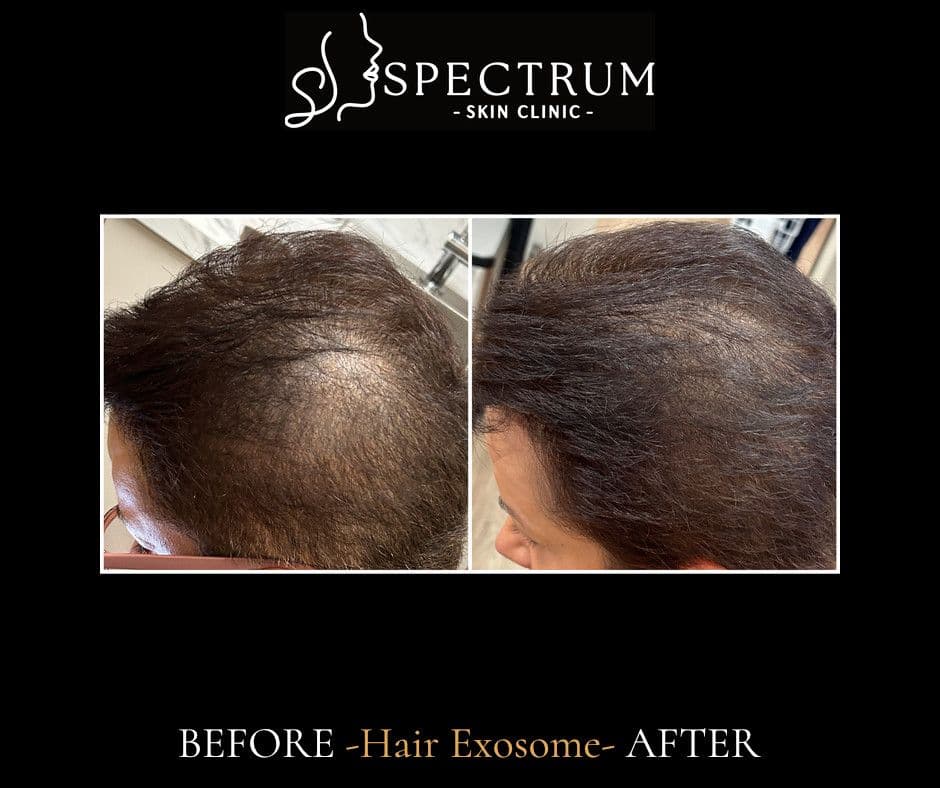
Where she started
At her first documented session, the thinning read as a diffuse loss of density rather than a bald patch, the part line was widening, the crown showed scalp through the hair, and the temples had receded. This is the typical pattern of female thinning, where hair miniaturizes across a zone instead of disappearing in one spot. Baseline photos like these matter: without them, a later 'after' image means very little.
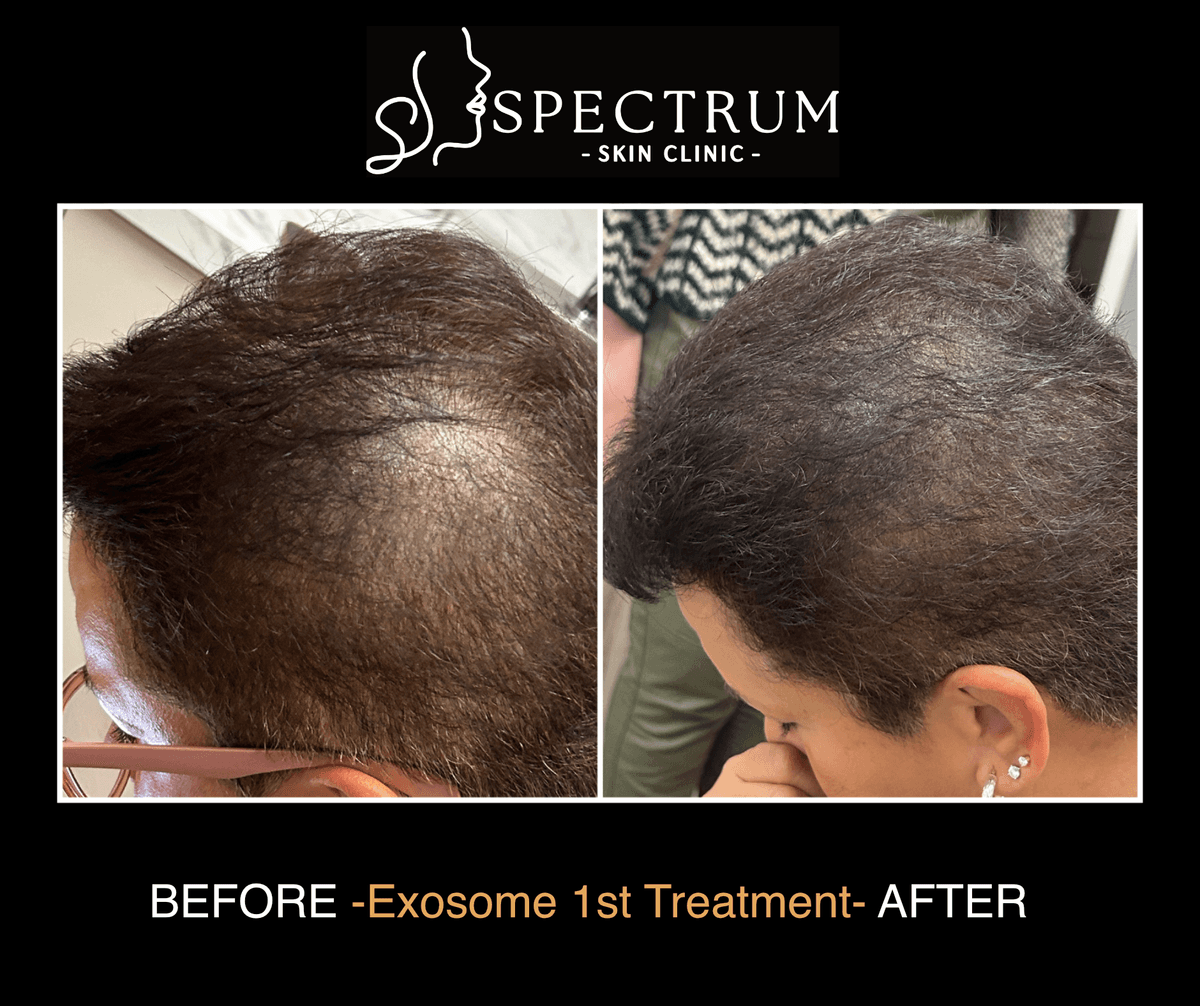
The first months: subtle, then real
Exosome signaling does not grow hair overnight. In the early months the change was subtle, slightly less scalp showing along the part, a little more coverage at the left part line. Early exosome response is often quiet, which is exactly why patients who judge it at four weeks tend to give up too soon. The follicles that respond do so over months, not days.
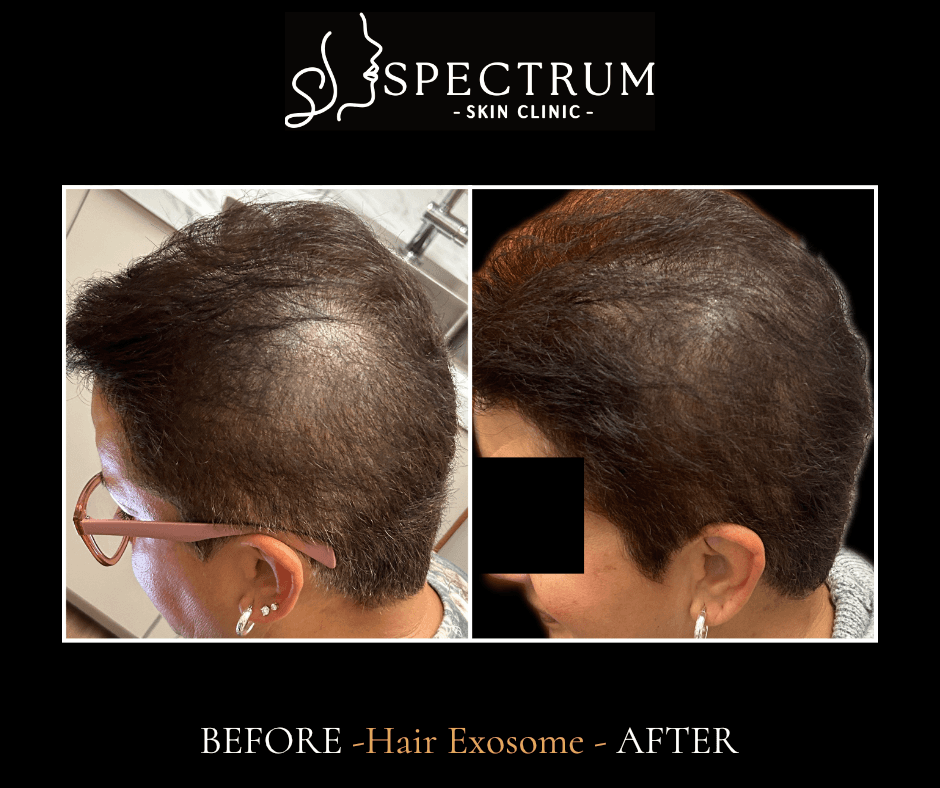
Several months in: fuller through the mid-scalp
By the later photos the density read fuller through the mid-scalp and crown. This is the window where most of the visible change tends to appear, once responsive follicles have cycled into a longer growth phase. How much a given patient gains depends on how early the thinning was caught, the underlying cause, and consistency with the treatment series.
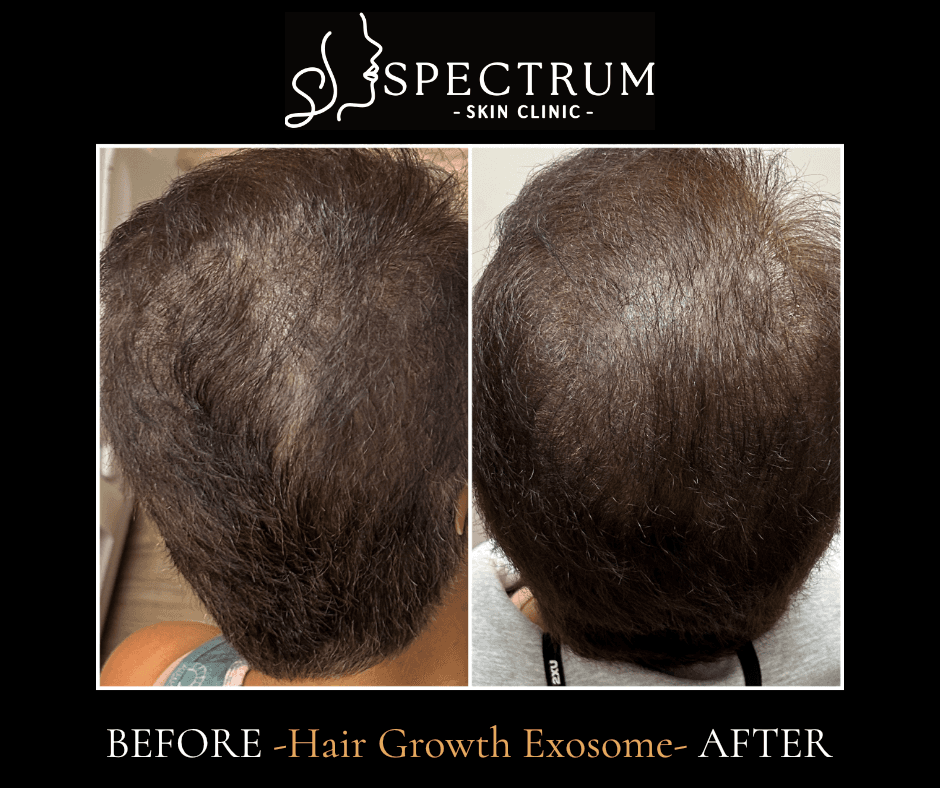
The frontal zone and temples
The frontal hairline and temples are usually the slowest and least predictable zones, frontal follicles are more stubborn than crown follicles. Here the temple and frontal density improved, though this is the region where expectations should stay most conservative. Exosome therapy supports and prolongs the follicles that are still viable; it does not regrow hair where the follicle is already gone.
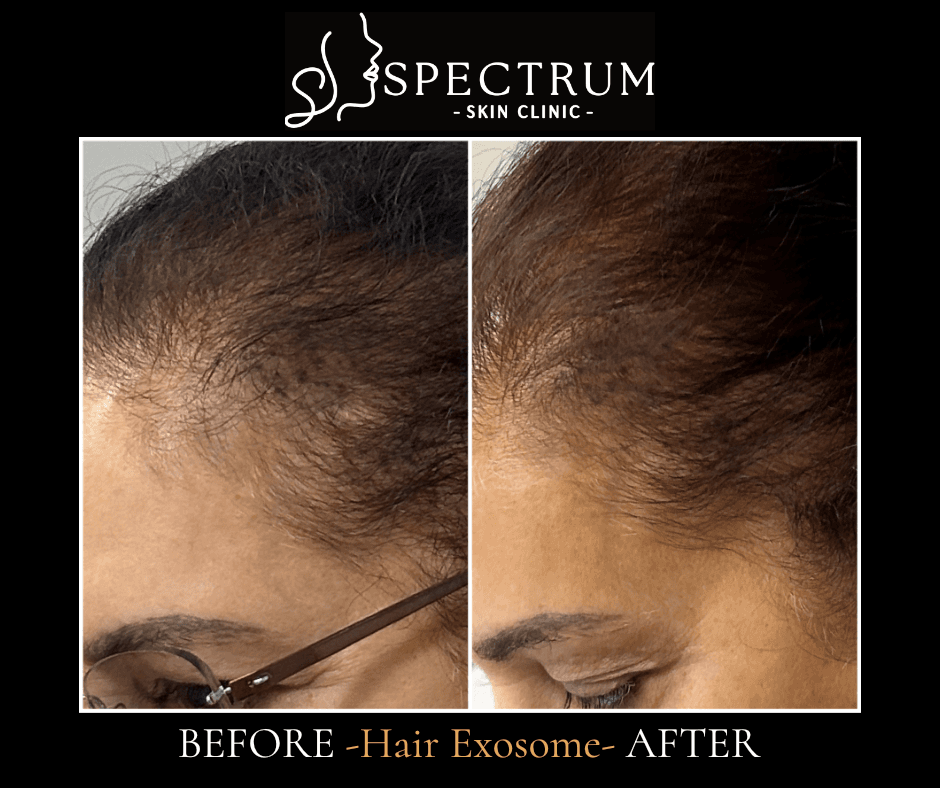
Where she is now: crown and top
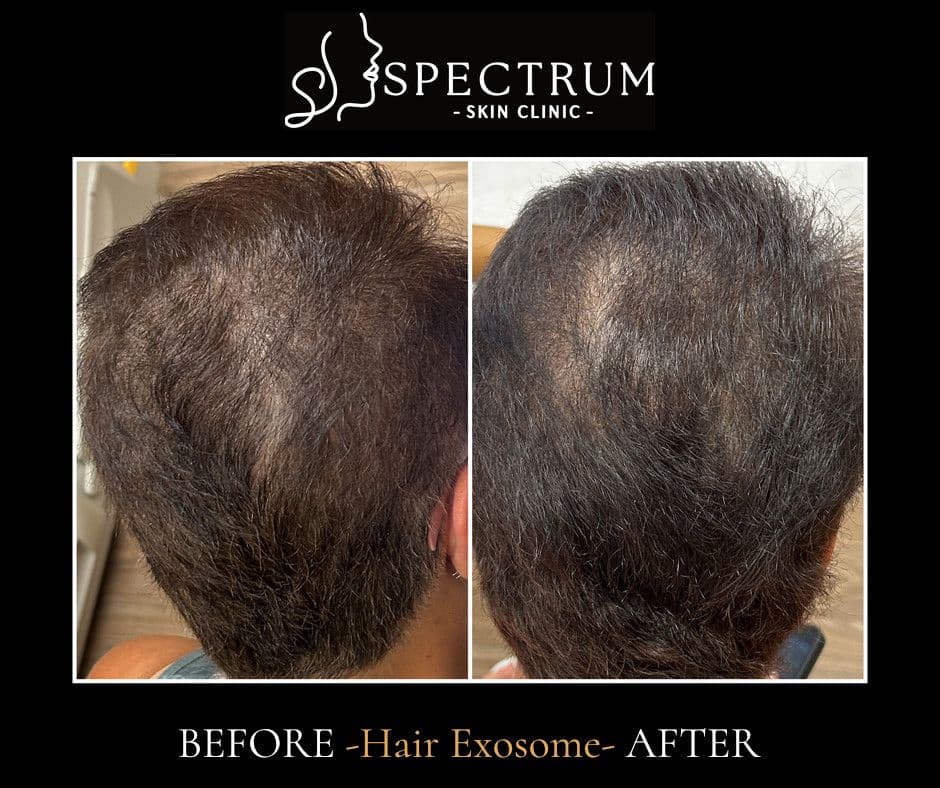
Most recently, around eight months from her first session, we photographed the result from several angles. Multiple angles matter because hair can look fuller in one lighting or parting and flatter in another; consistency across views is what separates a real result from a well-lit photo. From the top and crown, the scalp shows through far less than it did at baseline.
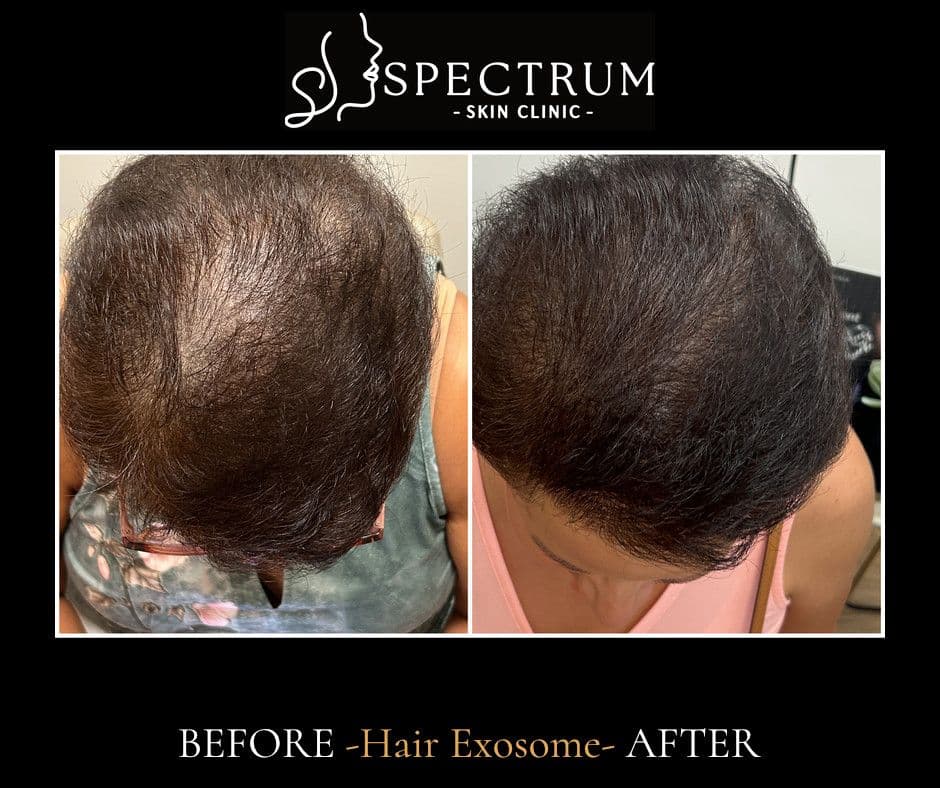
The same result, from the back
From behind, the vertex and occipital coverage track with what the top-down views show, denser coverage and less visible scalp than at baseline. Seeing the same improvement from the back is part of why a longitudinal, multi-angle record is more trustworthy than a single front-facing comparison.
Why exosome regrowth unfolds over months, not weeks
Exosomes are signaling packets, they carry growth factors that tell follicles to shift from a resting state into an active growth phase and to resist the miniaturization that drives pattern thinning. Because hair grows on a cycle, the follicles that respond do so on the follicle's timetable, not the patient's. That is why exosome hair therapy is run as a series with maintenance, and why the honest unit of measurement is months. In selected patients the gains hold with periodic sessions; in others the response plateaus. It depends on the cause and stage of the loss.
Who responds, and who doesn't
Exosome therapy tends to do the most for early-to-moderate, diffuse thinning where viable follicles remain, often female pattern thinning, telogen shedding that has stabilized, or as support alongside other treatments. It does the least for long-standing, fully bald zones and scarring hair loss, where the follicle is no longer there to stimulate. A scalp evaluation with Dr. Sabeen Munib is how candidacy is decided; some patients are better served by a different or combined approach.
How to read a hair before-and-after
Lighting, hair length, whether it is wet or dry, the exact parting, and camera angle can all manufacture or hide a result. When you look at hair regrowth photos, ours or anyone's, look for the same parting and angle, consistent lighting, and ideally more than one timepoint on the same person. A single dramatic before-and-after is the easiest thing to stage; a documented timeline is the hardest.
What exosome hair therapy costs, and what drives the price
Exosome hair therapy is almost always priced as a series rather than a single visit, because the result depends on completing the recommended sessions. What a given plan costs comes down to a few things: how many sessions the scalp needs, how much area is being treated, the exosome product used, and whether it is combined with other treatments. Because of that, a meaningful price comes from a scalp evaluation rather than a flat number online, and the most expensive plan is usually the one done halfway and abandoned, since a partial result tends not to hold. We give a clear per-session and full-series quote at consultation.
Exosome therapy vs PRP, PRFM, and other options
Exosome therapy is one tool among several. The closest comparison is platelet-rich plasma (PRP) and its relative PRFM, which concentrate growth factors from the patient's own blood; exosomes instead deliver a more concentrated, standardized package of signaling factors derived from cells. Neither is a transplant, surgical restoration relocates existing follicles and is a different category for more advanced loss. Medical options such as minoxidil, and prescription therapy in appropriate patients, work by a different mechanism and are often used alongside in-office treatment rather than instead of it. Which approach fits depends on the cause and stage of the loss, how the follicles have responded before, and a patient's preference for in-office versus daily at-home routines. That is what a scalp evaluation sorts out.
Is exosome therapy for hair safe? Side effects and FDA status
In-office exosome treatments are generally well tolerated; the most common effects are short-lived, mild scalp tenderness, redness, or slight swelling at the treated areas for a day or two. The more important point is regulatory: exosome products are not FDA-approved for hair loss, and the FDA has cautioned against unapproved exosome therapies marketed for various conditions. That is not a reason to avoid them, but it is the reason the source of the product and physician oversight matter. This is a treatment to have evaluated and performed in a medical setting, not bought as a kit. Anyone with an active scalp infection, certain medical conditions, or who is pregnant should be assessed individually.
Common questions about exosome hair therapy
Does exosome hair therapy hurt? Most patients describe it as minimal. The scalp is the main sensation, and any tenderness is usually brief.
How many sessions will I need? It is typically a short series spaced over weeks to months rather than a one-time treatment. The exact number is set after a scalp evaluation, based on the cause and stage of the thinning.
Is exosome therapy FDA-approved for hair loss? No. Exosome products are not FDA-approved for hair loss, which is why physician oversight and product sourcing matter and why this is best done in a medical setting.
How long do results last? Results build over months and are maintained with periodic sessions. Without maintenance, gains tend to fade as the underlying thinning continues. Duration varies from patient to patient.
Is it a permanent fix? No treatment for pattern thinning is permanent. Exosome therapy supports and prolongs viable follicles; it is managed over time rather than cured once.
See whether exosome therapy fits your hair loss
If your thinning is early and the follicles are still there, exosome therapy may be worth discussing. The first step is a scalp evaluation to identify what is actually driving the loss and whether exosome therapy, on its own or combined, is the right fit.
Individual results vary. The photos here reflect one patient's response over time and are not a guarantee of outcome. Results shown are not necessarily typical and depend on the cause and stage of hair loss, the treatment plan, and consistency with the recommended series. Photos used with patient consent.