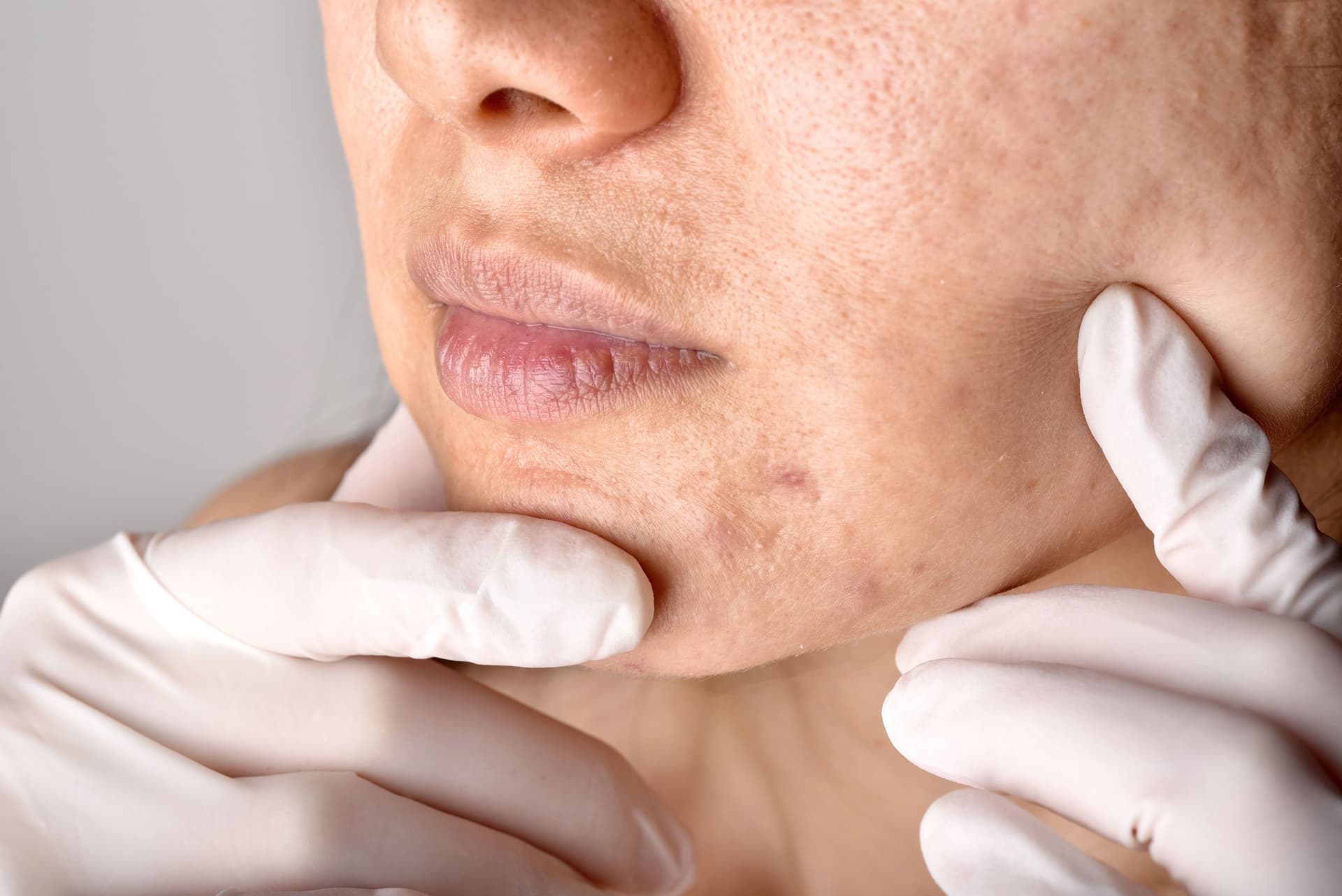
Microneedling for Acne Scars in Irvine, CA
Physician-performed RF microneedling for atrophic acne scars in Irvine, CA.
Microneedling for Acne Scars in Irvine, CA
Microneedling treats acne scars by remodeling scar tissue beneath the surface rather than polishing the top layer of skin. At Spectrum Skin Clinic in Irvine, Sabeen Munib, MD uses fractional RF microneedling to rebuild the depressed floor of atrophic acne scars, the rolling and boxcar scars left behind after inflammatory or cystic acne resolves.
How well microneedling treats acne scars depends on matching needle depth and energy to the scar type. Rolling scars and shallow boxcar scars respond well to skin needling; narrow ice pick scars usually need an added technique. The plan is set during a physician assessment, not applied as one fixed protocol.

Microneedling for Acne Scars at a Glance
| Starting price | Google rating | Patient reviews | Physician-performed | Experience |
|---|---|---|---|---|
| From $400 / session | 5.0★ Google | 441+ across platforms | 100% by Sabeen Munib, MD | 15+ years |
Spectrum Skin Clinic — Irvine
114 Pacifica, Suite 280, Irvine, CA 92618 · (949) 259-4790
Why Patients Choose Spectrum Skin Clinic for Microneedling Acne Scar Treatment
Every microneedling treatment at Spectrum is performed by Sabeen Munib, MD. Scar assessment, depth selection, and the decision to combine techniques are made by a physician, not delegated to a technician. Microneedling for acne scars is most predictable when the person reading your skin texture and choosing the device settings is the same physician experienced in scar revision, the standard you would expect from a dermatologist treating atrophic scarring.
That matters because acne scarring is rarely one scar type. Most faces show a mix of rolling, boxcar, and ice pick scars at different depths, and the right response changes across the cheek, temple, and jawline. Reading that map is a clinical judgment, and it drives everything from energy level to whether microneedling alone is enough.
Medically reviewed by Sabeen Munib, MD.

Which Acne Scars Microneedling Treats Best
| Scar type | How microneedling performs | What it depends on |
|---|---|---|
| Rolling scars | Strong fit, often the primary treatment | Tethering bands and scar depth |
| Shallow boxcar | Good fit for textural remodeling | Wall definition and scar count |
| Deep boxcar | Helps, sometimes with subcision or resurfacing | Base depth |
| Ice pick scars | Limited alone, usually an adjunct to TCA CROSS | Channel width and depth |
| Atrophic mixed scarring | Core indication for RF microneedling | Overall texture and skin type |
How Microneedling Works to Remodel Acne Scars
Microneedling uses fine needles to puncture the skin in a controlled, repeating pattern, creating thousands of micro-channels in the dermis. These tiny, minimally invasive injuries trigger the body’s wound-healing response, which lays down new collagen and elastin in the treated area. This process is called collagen induction therapy, and it is what gradually rebuilds the depressed base of an atrophic acne scar from below.
The reason microneedling works on depressed scars is structural: acne scars form when inflammation destroys collagen and the overlying skin collapses into the gap. Stimulating new collagen and elastin where it was lost raises the scar floor toward the surrounding surface, softening the shadow that makes a scar visible.
Fractional RF microneedling adds radiofrequency heat at the needle tip, delivered at selected depths through the same micro-channels. The thermal remodeling from the microneedling device reaches deeper rolling and boxcar scars that surface treatments leave untouched, while the fractional pattern leaves islands of intact skin between channels to speed healing.
Depth and energy are matched to scar depth, facial zone, and skin type during assessment. A deep boxcar scar on the cheek and a shallow rolling scar on the temple are not treated at the same setting, part of why physician-set parameters matter more than the brand of needling device.

What to Expect: Sessions and Timeline
| Stage | Timeframe | What to expect |
|---|---|---|
| Each session | 60–90 minutes | Includes topical numbing, so the treatment is well tolerated |
| Immediate downtime | 2–5 days | Redness and mild swelling across the area, like a sunburn that fades quickly |
| Treatment course | 3–6 sessions, 4–6 weeks apart | Number depends on scar severity and type — deep or dense scarring needs more sessions than a few shallow rolling scars |
| Collagen remodeling | 3–6 months | Results build gradually as new collagen forms, not all at once |
| Final results | Assessed a few months after the last session | New collagen has matured; the realistic goal is a meaningful, lasting reduction in scar visibility — no treatment erases scarring entirely |

Benefits of Microneedling for Acne Scars
The main benefit of microneedling for acne scars is durable structural change. Because it rebuilds collagen rather than resurfacing the top layer, improvement in acne scars tends to hold as the remodeled tissue matures, and overall skin texture and tone often improve alongside the scars themselves.
Microneedling also improves skin texture more broadly, enlarged pores, fine lines, and uneven skin tone frequently soften in the same treatment area, since the collagen response is not limited to the scar floor. For mild to moderate acne scars, microneedling is one of the lower-downtime options that still reaches the dermis, which is why it is often the starting point in a multi-session plan before more aggressive resurfacing is considered.
RF Microneedling vs Laser for Acne Scars
RF microneedling delivers energy through microneedles, sparing more of the surface than a fully ablative laser and carrying lower pigment risk, a meaningful advantage for darker skin tones, where heat-based resurfacing can trigger post-inflammatory hyperpigmentation. Fractional laser resurfaces the surface directly and can be stronger for some textural scarring, but it asks more of the skin barrier and more downtime.
Neither is universally better. The choice depends on scar type, skin type, downtime tolerance, and pigment risk. Some plans sequence both, or pair microneedling with chemical reconstruction of skin scars (the TCA CROSS technique) for narrow ice pick scars that energy devices reach poorly. The point of the consultation is to decide which combination fits your scars rather than to default to one device.

Microneedling with PRP or PRFM for Acne Scars
Platelet-rich plasma (PRP) or PRFM can be applied with microneedling to add concentrated growth factors to the healing response, drawn from a small sample of your own blood and delivered into the fresh micro-channels.
The aim is to amplify new collagen formation and speed recovery. Whether PRP or PRFM adds meaningful benefit over microneedling alone depends on the case, scar depth, skin type, and how your skin has responded to prior treatment, and it is discussed at consultation rather than added by default.
At-Home Microneedling vs In-Office Treatment
At-home microneedling with a dermaroller is not the same treatment. Home rollers use short, fine needles that mostly reach the epidermis; they cannot deliver the controlled dermal depth or the radiofrequency energy that remodels a scar floor, so they do little for atrophic acne scars and can irritate or damage your skin if used aggressively on active acne.
In-office microneedling uses a precision needling device with adjustable depth, sterile single-use tips, and, with RF, calibrated energy, all set by a physician after reading your scar pattern. For acne scarring specifically, that depth control and the option to combine techniques are what separate a treatment that changes the scar from one that only refreshes the surface.

A Good Candidate
Controlled acne with residual rolling or boxcar scarring, mild to moderate acne scars, realistic expectations, and no active infection in the treatment area. Most skin types are suitable, and RF microneedling is often preferred for darker skin.
When Microneedling Is an Adjunct
Narrow ice pick scars or very deep boxcar scars often need TCA CROSS (chemical reconstruction of skin scars), subcision, or fractional resurfacing alongside microneedling rather than microneedling alone.

When to Wait
Active inflammatory or cystic acne, recent isotretinoin, active skin infection, or a tendency to keloid scarring warrant a different plan or different timing. These are reviewed before any microneedling is scheduled.
What Affects Your Cost
Cost depends on the number of sessions and whether microneedling is combined with other techniques such as TCA CROSS or subcision. RF microneedling with Secret PRO starts at $1,200 per session. Package pricing is available for multi-session plans, with financing through Cherry and CareCredit. Your final plan and pricing are confirmed at consultation once your scar type is assessed.
Related Treatments
This page sits under Acne Scar Treatment in Irvine, the multi-modality hub for ice pick, rolling, and boxcar scars.
For microneedling across other concerns, see Microneedling at Spectrum. Compare resurfacing in Microneedling vs Laser for Acne Scars.
See outcomes in the acne scar before and after gallery, or review care for active breakouts at Acne & Acne Scar treatment.
Learn more about microneedling for acne scars and how it rebuilds skin.
Book Microneedling for Acne Scars in Irvine
Schedule a consultation with Sabeen Munib, MD to assess your scar type, confirm whether microneedling alone or a combination is right for your skin, and design a treatment plan.
Patient Reviews
4.97★ · 441 Patient Reviews

I had an amazing experience with Dr. Munib, who performed my aesthetic treatments including Pico laser, Botox, a glassy facial, Botox for migraine, and HIFU. Every procedure was done with great care, precision, and professionalism, and the results exceeded my expectations. Dr. Munib is incredibly knowledgeable and takes the time to explain everything, making me feel comfortable and confident throughout the process. Her expertise truly shows in her work. The staff was extremely accommodating, friendly, and professional, which made the entire experience even better. On top of that, the prices were very reasonable for the quality of service provided. I highly recommend Dr. Munib to anyone looking for outstanding aesthetic treatments and excellent patient
Mahjabeen Saeed
4 months ago

I had an excellent experience with Dr. Sabeen Munib at Spectrum Skin Clinic in Irvine. I visited her for acne scar treatment and underwent three subcision sessions spaced six weeks apart. Throughout my treatment, I was consistently impressed by her expertise, attention to detail, and compassionate approach. Dr. Munib took the time to carefully evaluate my scars, explain the procedure, and answer all of my questions before starting. During each procedure, she made sure I was comfortable and informed every step of the way. Her technique, skill and experience with acne scar subcision gave me complete confidence that I was in capable hands. The entire team at Spectrum Skin Clinic was professional, friendly, and supportive throughout the process. Although acne scar improvement takes time and healing, I appreciate that Dr. Munib focuses on achieving the best possible long-term results rather than making unrealistic promises. She explained what to expect during recovery and emphasized that collagen remodeling happens gradually. If you're looking for a knowledgeable and caring physician for acne scar treatment or subcision, I highly recommend Dr. Sabeen Munib Spectrum Skin Clinic, Irvine. I truly appreciate the care, professionalism, and dedication I received and would not hesitate to recommend her to anyone seeking advanced scar treatment.
Deepak Jadhav
3 months ago

After several aesthetic nurses told me I was allergic to filler dissolver, Dr. Munib took a careful, evidence-based approach. She used ultrasound to locate my migrated lip filler, tested a small area first, and explained I was reactive—not allergic. She dissolved a small test area before safely treating my upper lip. Throughout the process she was gentle, thorough, and educational. It’s a long drive for me, but her knowledge and expertise make it absolutely worth it.
Jamel Neill
2 months ago

Thank GOD for Dr. Munib. She is the angel of dissolver!!! I had HA nodules and Sculptra nodules from previously going to Dermfx and I went to Dr. Munib for ultrasound guided dissolving. She is gentle, patient, knowledgeable, kind and funny. I feel like she is the last of the good ones in this business. If you are interested in natural looking aesthetic results that aren’t botched and don’t cause you years of facial pain go to her. I would try to see her as my primary doc if I wasn’t moving out of the area. I would travel to go see her though.
Siena Viencek-Walsh
3 months ago
Real Patient Results
All treatments performed personally by Sabeen Munib, MD at Spectrum Skin Clinic, Irvine.
Related Blogs
Personalized Aesthetic & Regenerative Solutions Designed to Heal, Enhance & Restore Naturally





Frequently Asked Questions
Got questions? We’re here to help! Find out what we offer, how to book an appointment, where we’re located, and more. We treat all age groups and offer skincare products too.