PicoWay vs PicoSure: Which Picosecond Laser Is Right for You
The short answer
PicoWay and PicoSure are both picosecond lasers, meaning they deliver energy pulses in trillionths of a second, much faster than traditional Q-switched nanosecond lasers. Both have FDA-cleared indications for pigment and tattoo-related uses, depending on the wavelength and handpiece. They are not interchangeable.
The differences come down to wavelengths, mechanism, and what each one is calibrated to do well. At Spectrum Skin Clinic in Irvine, we operate the Candela PicoWay platform because of how it performs in melanin-rich skin and on multi-color tattoos. This blog explains why, and when PicoSure might be the right call instead.
What both lasers have in common
Picosecond technology was the breakthrough that changed pigment and tattoo treatment in dermatology. Older Q-switched lasers used nanosecond pulse durations and relied heavily on photothermal effects, heat building up in the target. Picosecond lasers shifted the balance toward photomechanical effects, the rapid pressure wave breaks pigment particles apart with less collateral heat to surrounding tissue.
The clinical goal is cleaner pigment targeting with less unwanted heat in surrounding skin. For Fitzpatrick IV-VI patients, that conservative heat profile matters because inflammation can trigger rebound pigment.
Both PicoWay and PicoSure operate in the picosecond range. Beyond that, they diverge.
Where PicoWay and PicoSure differ
Wavelengths available:
- PicoWay delivers 532 nm, 785 nm, and 1064 nm wavelengths
- PicoSure delivers 532 nm, 755 nm, and 1064 nm wavelengths
The 785 nm vs 755 nm difference is meaningful for blue, green, and purple tattoo ink, PicoWay's 785 nm hits a slightly different absorption peak that handles some difficult ink colors better. PicoSure's 755 nm Alexandrite wavelength has its own strengths, particularly for tattoo ink and certain pigment types.
Pulse duration:
- PicoWay: roughly 300–450 picoseconds depending on wavelength
- PicoSure: roughly 550–750 picoseconds depending on wavelength
PicoWay's shorter pulse durations are designed to emphasize photomechanical pigment disruption with less heat contribution, which is one reason we like it for patients at higher pigment-rebound risk.
Best at:
- PicoWay: pigmentation in skin of color, melasma at low fluence, multi-color tattoo removal, sun spots in mixed Fitzpatrick populations
- PicoSure: focus lens array (Focus) treatments for skin texture and rejuvenation, certain tattoo ink colors
When PicoWay is the better choice
We chose PicoWay for Spectrum specifically because of our patient population. Irvine is one of the most ethnically diverse cities in California, and a meaningful portion of our patients are Fitzpatrick IV, V, and VI. The shorter pulse durations and the specific wavelength set on PicoWay handle these patients with a conservative treatment window compared with many older pigment approaches.
PicoWay is also our default for:
- Multi-color tattoo removal where greens, blues, and purples are present
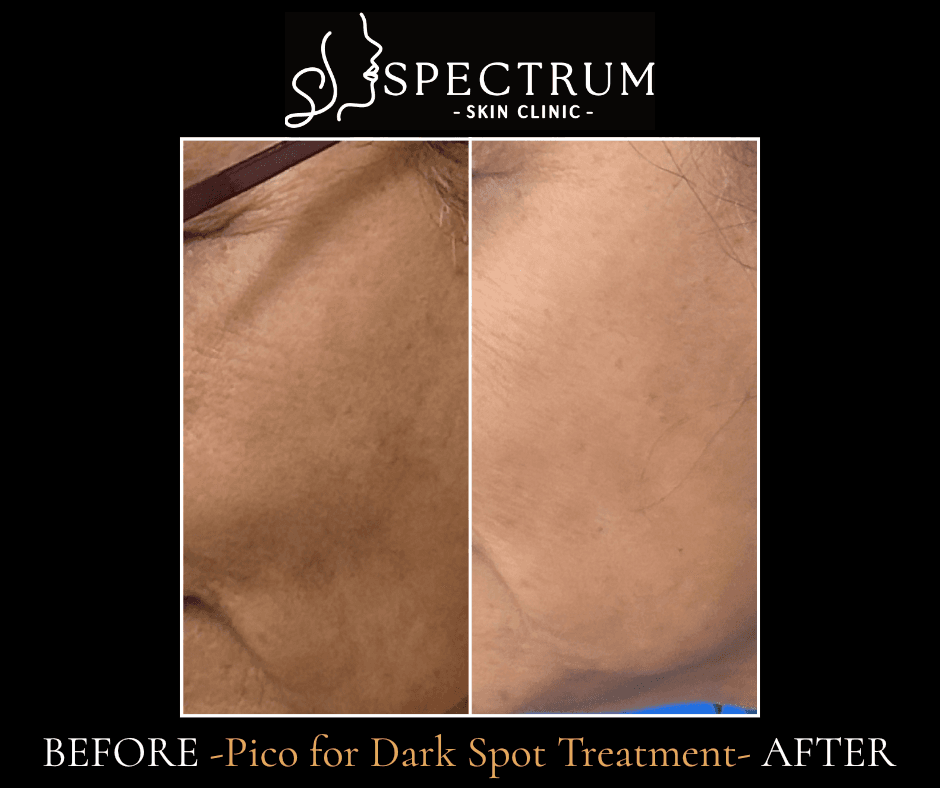
- Sun spots and solar lentigines in patients across all Fitzpatrick types
- Selected melasma cases treated at low fluence as part of a broader plan
- Post-inflammatory hyperpigmentation that has stabilized
- Patients who have had prior laser-induced pigment worsening at other clinics
When PicoSure might be the better choice
PicoSure has earned a strong reputation in two areas:
- Focus treatments for skin rejuvenation: the Focus lens array creates LIOBs (laser-induced optical breakdown) for collagen stimulation. It is a specific technique with good clinical literature for texture and fine line improvement.
- Certain stubborn tattoo ink colors: 755 nm has strengths in some inks PicoWay's 785 nm handles less efficiently.
If you have a tattoo that has been partially treated and stalled, asking specifically which wavelengths have been used, and which are needed for what remains, is a fair question. Some patients ultimately need multiple platforms over the course of complete tattoo removal.
What matters more than which platform
The single largest variable in laser outcomes is not the device, it's the provider. A skilled operator on PicoSure will outperform an inexperienced operator on PicoWay every time. Settings, fluence, spot size, pulse spacing, and pacing across sessions matter more than the brand.
At Spectrum, every PicoWay session is performed by Dr. Sabeen Munib personally. We do not delegate laser energy delivery. This is intentional, the difference between a clean treatment and a rebound case often comes down to settings calibrated in real time during the session.
What to ask any clinic before booking
If you are deciding between clinics with different platforms:
- Which exact wavelengths does the device offer
- Who performs the treatment, physician, NP, RN, or technician
- How many test spots will be performed at 2–4 weeks before the first full session, especially if you are Fitzpatrick IV–VI
- What the fluence and interval-spacing protocols are for darker skin types
- What happens if the response is unexpected, escalation, de-escalation, or pause
A clinic that can't answer these specifically is not the clinic to choose.
Book a consultation in Irvine
If you are considering picosecond laser for pigmentation or tattoo removal, the device matters less than the diagnosis and the operator. Dr. Sabeen Munib evaluates each case at Spectrum Skin Clinic and recommends what fits your skin and your goal, not what fills a same-day schedule.
Book a consultation, or learn more about the PicoWay platform at Spectrum.