Fordyce Spots on the Lips: What They Are and How We Treat Them in Irvine
Medically advised by Dr. Sabeen Munib, MD.
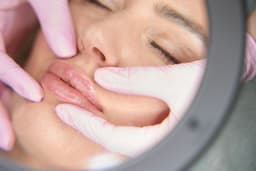
Fordyce spots are small, pale or yellowish bumps that appear along the border of the lips and inside the mouth. They are common, harmless, and not a sign of infection. If you have noticed a row of tiny dots on your upper lip and wondered what they are, this guide explains what they are, why they appear, how they are diagnosed, and your treatment options if you would like them to be less visible.
What Are Fordyce Spots?
Fordyce spots are ectopic sebaceous glands, which means sebaceous oil glands that sit in places where they become visible at the surface. In most of the body a sebaceous gland empties into a hair follicle and stays hidden. On the lips and the oral mucosa there are no hair follicles, so the sebaceous glands show through as tiny raised dots. Their clinical appearance is consistent from person to person: one to three millimeters across, pale white to yellow, slightly elevated, and painless. On the upper lip they often line up along the border, which is where most people first notice them. They are extremely common, and a large share of healthy adults have them somewhere, which is part of why physicians consider them a normal, benign variant rather than a disease.
Where Do Fordyce Spots Appear?
Fordyce spots can show up in more than one place, and it is the same ectopic sebaceous gland in each. On the face they appear along the vermilion border of the lips and across the inside of the cheeks and the oral mucosa, where they are sometimes called Fordyce granules. They also commonly occur on genital skin, including the shaft of the penis and the scrotum in men and the labia in women. In every location the finding is benign, and it does not need treatment unless a person wants it addressed for cosmetic reasons. Because they can appear on genital skin, they are sometimes mistaken for something contagious, which is worth clearing up directly.
What Causes Fordyce Spots?
Fordyce spots are present from birth, though they often become more noticeable after puberty, when hormonal changes cause the sebaceous glands to enlarge. They can also look more prominent when the skin is stretched, or simply become easier to see with age. They are not caused by poor hygiene, diet, skin care habits, or anything you did, and they are not contagious. You cannot pass them to another person, and they are not a wart or an infection. Men and women are affected in similar ways, and the spots tend to be more visible in people with thinner or fairer lip skin.
Are Fordyce Spots HPV or a Sign of Something Serious?
A common worry is that Fordyce spots are one of the sexually transmitted infections, such as HPV. They are not. Fordyce spots are your own sebaceous glands, not a virus, and they do not spread through contact. It helps to know how they differ from the conditions people confuse them with:
- tend to be rougher, can grow or cluster over time, and are caused by a virus.
- firm white keratin cysts that are usually round and dome-shaped.
- painful and blistering, and they come and go.
Fordyce spots, by contrast, stay put, do not hurt, and do not change quickly. That said, if a bump bleeds, grows, becomes painful, or changes color, it is worth having a physician look at it in person to rule out anything else. When there is any doubt, an in-person exam is the honest answer.
How Are Fordyce Spots Diagnosed?
In most cases a physician can identify Fordyce spots on sight, and no test is needed to reach a confident diagnosis. In dermatology the clinical appearance is well recognized, so Fordyce spots are usually diagnosed by eye during a brief exam. Occasionally we look more closely with dermoscopy, and a biopsy is very rarely used, only when the appearance is not typical or another condition needs to be ruled out. Many patients find that simply having the bumps diagnosed as Fordyce spots, and hearing that they are benign, is the reassurance they were looking for, and they need nothing further.
Do Fordyce Spots Go Away on Their Own?
In most cases Fordyce spots do not disappear completely on their own, though they can look less noticeable at times. Because they are harmless, there is no medical need to remove them. Treatment is a personal, cosmetic choice for people who would prefer them to be less visible. There is no cream or home remedy with reliable evidence behind it, and picking or squeezing them can cause scarring, so that is best avoided.
Treatment Options in Irvine
When someone would like Fordyce spots reduced for cosmetic reasons, several treatment options exist, and the most established is laser treatment. At Spectrum Skin Clinic, this is performed by Dr. Sabeen Munib, MD, not delegated to a technician. A carbon dioxide, or CO2, laser gently treats the enlarged gland tissue so the surface looks smoother, and a similar erbium laser can be used on the delicate lip border. Published case reports describe the CO2 laser as an effective approach for Fordyce spots, and the CO laser remains a common choice for spots on the lip. Other treatment options include electrocautery and micro-punch surgery, and the right choice depends on where the spots are and how prominent they look.
Because the lip is delicate, our approach is conservative. We assess the area first, treat gradually, and prioritize keeping the natural look and function of the lip. Side effects are usually limited to temporary redness or mild swelling, and we review the likely side effects and the short downtime before we begin, so patients know what to expect. Most patients return to normal daily activity quickly, and we follow up if a second session would help. Results vary from person to person. Some spots respond better than others, and more than one session is sometimes needed. We will tell you honestly what treatment is likely to achieve for your case at a consultation, including whether it is likely to help at all.
Some patients ask about topical treatments, such as prescription retinoids. The evidence for creams is limited, and they are not a reliable way to remove Fordyce spots, which is why most patients who want treatment choose an in-office option. We will walk through what fits your skin and your goals at the visit, including a simple skin care routine to support healing afterward.
Is It Worth Treating?
For many people, simply understanding that Fordyce spots are a benign variant is enough, and they choose to leave them alone. For others, especially when the spots are prominent along the lip line, reducing them improves how they feel about their smile. Neither choice is wrong. Because treatment is elective and involves a sensitive area, the decision is best made after an in-person look, so we can confirm what the bumps are and talk through whether treatment is worthwhile for you.
Frequently Asked Questions About Fordyce Spots
Do Fordyce spots on the lips go away?
They usually persist rather than disappearing completely, though they can look less noticeable at times. They are harmless, so removal is optional and cosmetic.
What causes Fordyce spots?
They are sebaceous glands that are present from birth and often become more visible during puberty. They are not caused by hygiene, diet, or infection.
Are Fordyce spots HPV?
No. They are your own sebaceous glands, not a virus, and they are not among the sexually transmitted infections. If you are unsure whether a bump is a Fordyce spot or something else, an in-person exam can confirm it.
How do I get rid of Fordyce spots?
There is no proven cream. The most established choices are laser treatment, electrocautery, or micro-punch surgery, performed by a physician. Avoid picking or squeezing them, which can scar.
What triggers Fordyce spots to become more visible?
Hormonal changes during puberty and stretching of the skin can make them more prominent. They are still a benign finding and not a sign of a problem.